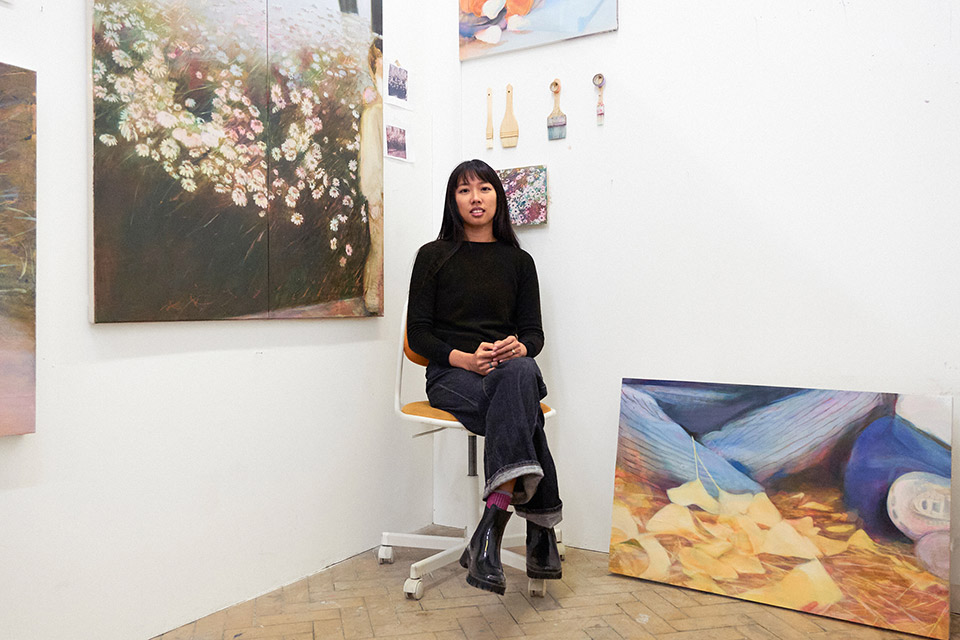
Sophia Rosenthal: Artist of the Month
Artist of the Month June 2026:
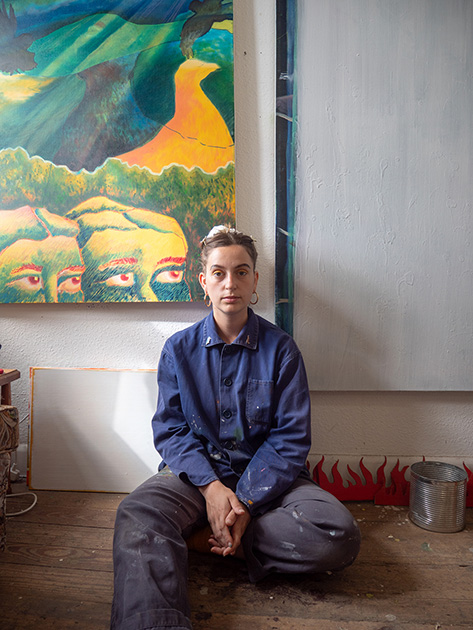
Sophia Rosenthal, selected and interviewed by Paul Newman for CBP.
Born in South Korea, raised in the Philippines, and now based in the UK, Sophia Rosenthal’s painting practice is rooted in a desire to explore memory – particularly in relation to identity, belonging, and migration. Working primarily from personal childhood photographs, Sophia is drawn to the unexpected or overlooked, yet charged details in these images, what Roland Barthes calls the punctum, and defines as the emotional or disruptive element that punctures the frame. These discoveries are at the heart of her current work.
CBP: You describe your paintings as based on your life and ideas around belonging. Can you introduce the background and subject matter to your work?
SR: I’ve always been deeply interested in photographs, although growing up I was surrounded by many different forms of visual culture. Both South Korea and the Philippines felt incredibly rich in this sense, full of music, cinema, television, craft, ornaments, and textiles. I grew up in a small village in the Philippines near a volcano, away from the hot intensity of Manila, and many of my earliest memories are very sensory and visual: rattan furniture, lacquered objects, ceramic figurines, my grandfather’s paintings, old analogue cameras, and family photographs. At the time, technology and media were rapidly expanding there, so even though I’m in the “internet generation”, I didn’t experience it that way.
Like many children, I was hyper observant and sensitive to atmosphere, detail, and the construction of things. In later years, my family moved frequently throughout my childhood – between the Philippines, Singapore, Taiwan, Thailand, and eventually the UK, largely because of my parents’ work and circumstances around childcare. I think that constant movement profoundly shaped my understanding of identity and what it means to belong. Much of my work comes from that feeling of existing between places and between states of arrival and departure.
Later, during years spent in Falmouth and Venice, I started to understand painting as a way of sitting longer with those unresolved experiences. My work has become less about documenting specific memories and more about reconstructing emotional atmospheres – trying to grasp something fleeting, partially lost, or difficult to fully articulate.
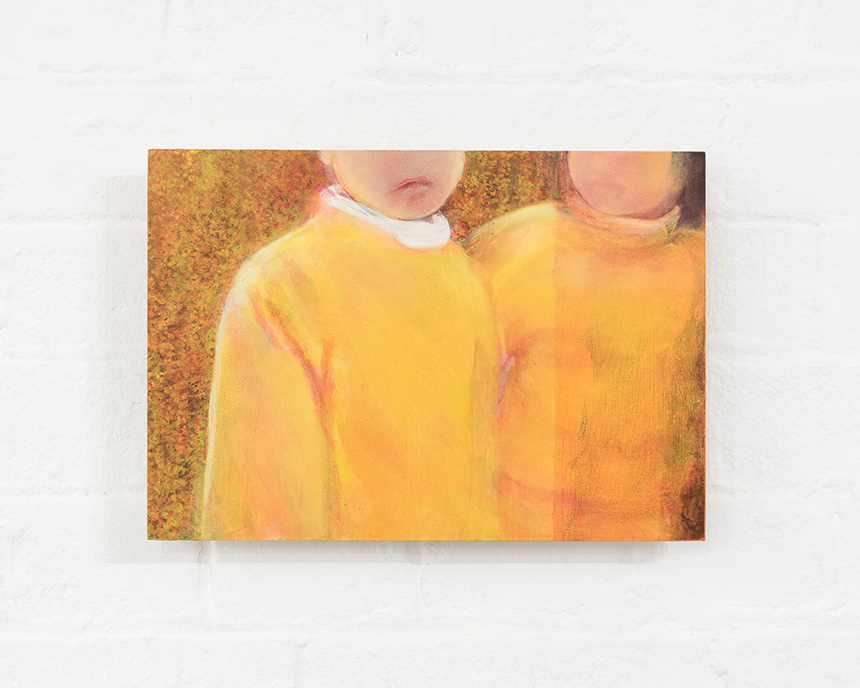
CBP: The paintings emphasise close up cropping, in connection to photographic referents, and in terms of something elusive and incomplete as a translation of your experiences. This presents a compelling narrative provocation for the viewer. Can you discuss the compositional strategies in your work?
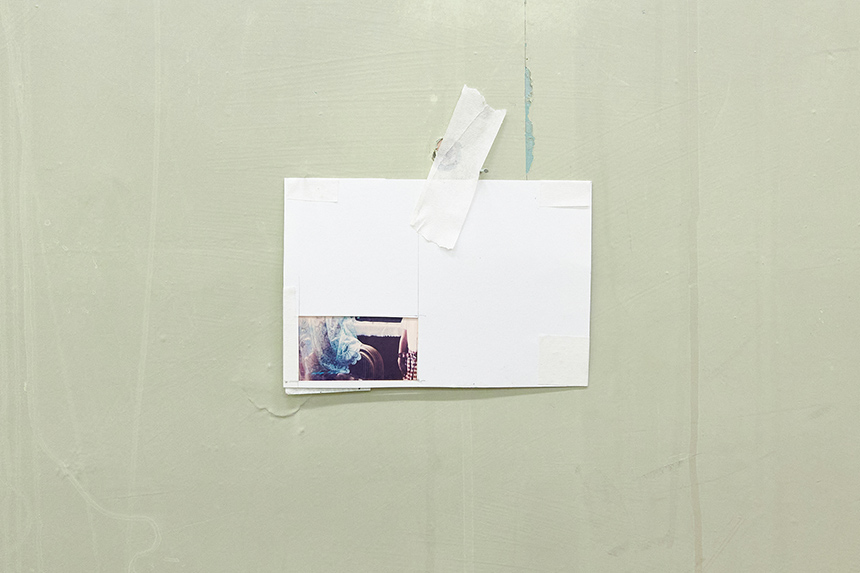
SR: Photography is central to my process. Many of the source images I work from are family photographs, which I cut up and cover using handmade viewfinders. I try to find an isolated fragment, and create a new image – a version of the photograph’s original context. I’m interested in moments where the image can feel like a glitch or could break down.
Photographs carry emotional residue across time, especially when other things in your life have been impermanent. Because my family lived quite nomadically, and many personal belongings were lost through moving or environmental damage, even photographs, so the remaining often became the only surviving traces of particular moments or relationships. Despite their small scale, they seem to contain entire worlds.
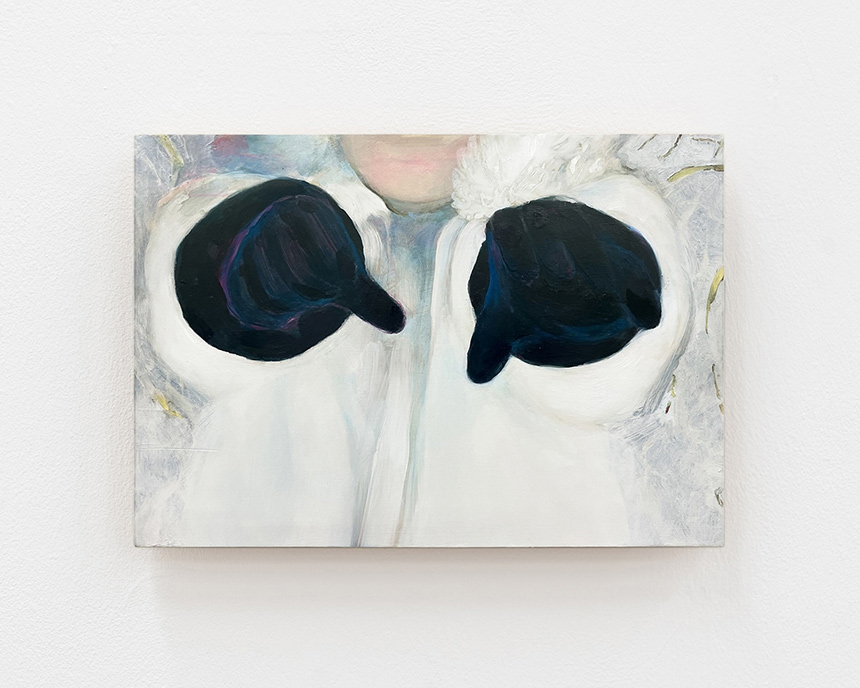
Cropping is important because it mirrors how memories actually are – selective, fragmented, and incomplete. I’m influenced by the language of photography and cinema, particularly ideas of zooming, interruption, and off-screen space. Often the most charged part of an image exists at its edge or just outside the frame.
By obscuring figures or removing contextual information, I want the image to resist a fixed reading. The compositions emerge intuitively through editing, masking, repainting, and reduction, allowing the viewer space to project their own associations into the work.
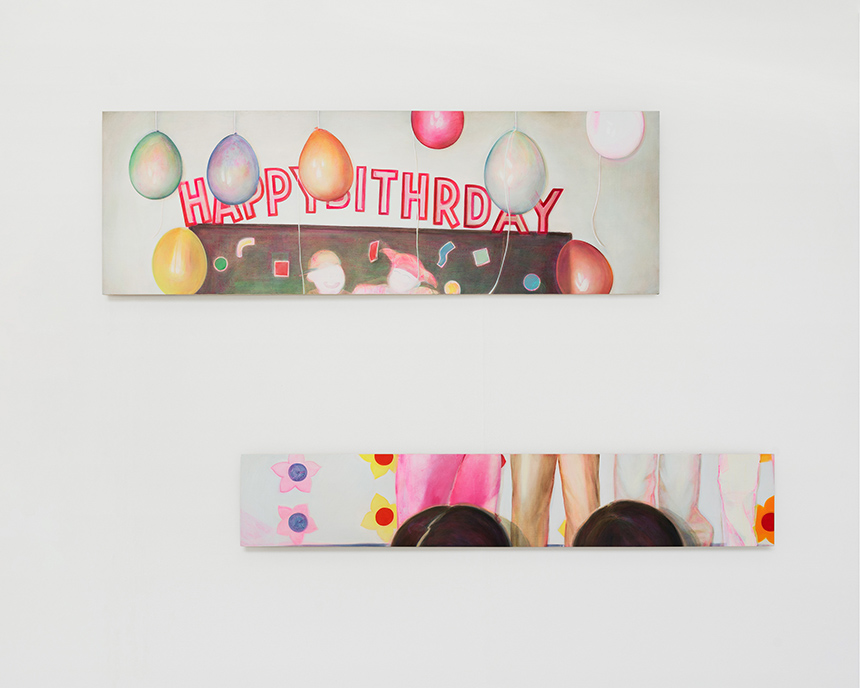
CBP: You relate your work to the notion of the ‘punctum’ a phrase coined by author Roland Barthes in ‘Camera Lucidia’ that identifies a specific element in a photograph that has an emotional hook and punctures the viewer with its resonance. Can you talk about how this concept is explored in your paintings?
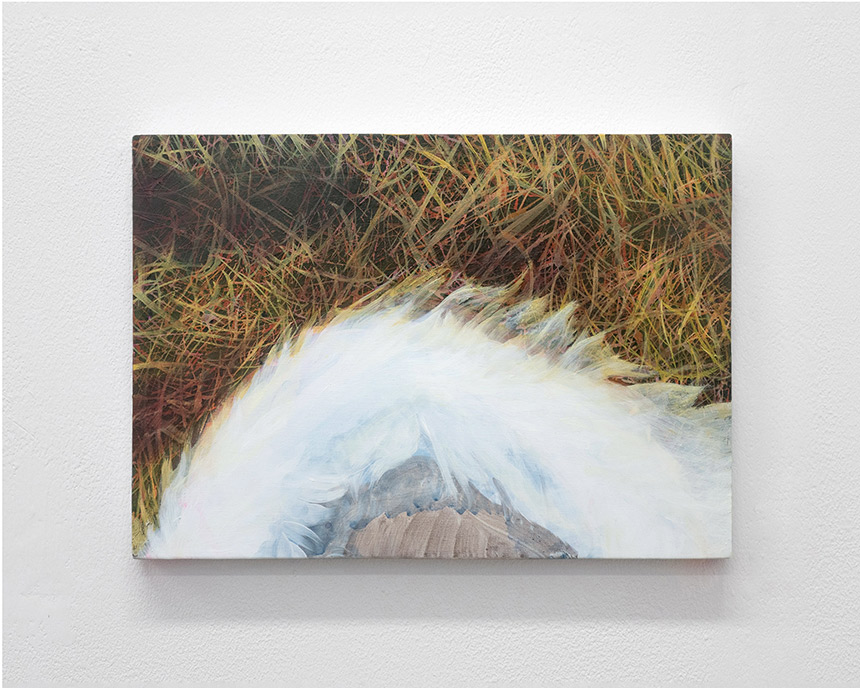
SR: ‘Punctum’ put a word to something I’ve always been drawn to. It’s often not the central subject of an image that carries the emotional weight, but a seemingly minor or accidental detail – a gesture, a hand, a fold of fabric, a particular quality of light, or something caught mid-action.
Those details hold a disproportionate emotional charge because memory rarely functions clearly or linearly. I tend to remember textures, temperature, light, and peripheral moments more vividly than complete narratives.
Painting allows those fragments to move away from description and towards something more poetic or symbolic. It allows me to enter this kind of state of undoing. As the image is translated through paint, certain details become heightened while others dissolve. I’m interested in that instability – where different temporalities can collapse into one another and where something recognisable gradually shifts into a sensation or suggestion.
I think that’s why the idea of the punctum connects so strongly to my broader interest in memory and belonging, which are unstable and continually negotiated. Through cropping, close framing, and painting I try to amplify those quieter tensions. As I paint, the image gradually reanimates and transforms through time, touch, and material revision. Disconnected from a fixed narrative or origin, the works begin to exist somewhere between remembering and inventing, shaped by distance, longing, and projection.
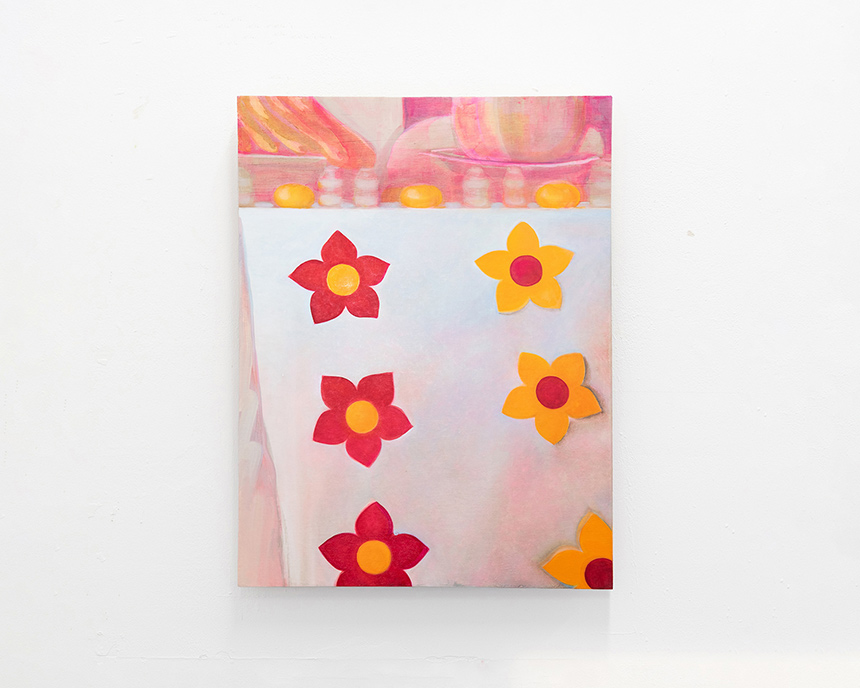
CBP: There is an ethereal dreamlike quality to your paintings with a particular colour palette that evokes a feeling of interiority. There is also an effect of light coming through the layers, which returns the work to a photographic distance, like the paintings are on a light box. Can you discuss your painting strategies for colour and the depiction of light in your work?
SR: Colour and light are central to the atmosphere of the paintings. I build images slowly through thin layers, glazing, staining, and wiping back paint so the surface retains a sense of depth and luminosity. I’m interested in light seeming to emerge from beneath the image, as though the painting is holding light internally.
A drawing teacher once told me to “use the white of the paper,” and although that was in relation to drawing, it shaped how I think about materials. I became aware that surfaces and pigments already possess their own inherent qualities. Later, while working for Colart in London, I learned a great deal about pigments, opacity, and the physical behaviour of paint, which encouraged me to experiment more materially, like glazing, layering different mediums and using masking fluid.
I’m particularly drawn to photographic conditions of light – overexposure, fading, dusk light, artificial interiors – moments where images feel suspended between appearing and disappearing. The colour palettes tend to emerge intuitively from an emotional place rather than realism. I’ve also been influenced by painters like Mamma Andersson and Phoebe Unwin, particularly in the way they allow material instability to visibly shape image, where small shifts in colour, texture, or composition can carry an emotional charge without resolving into narrative.
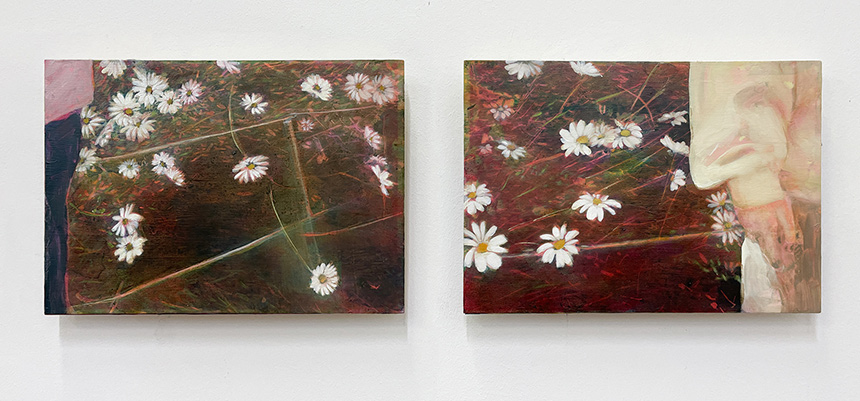
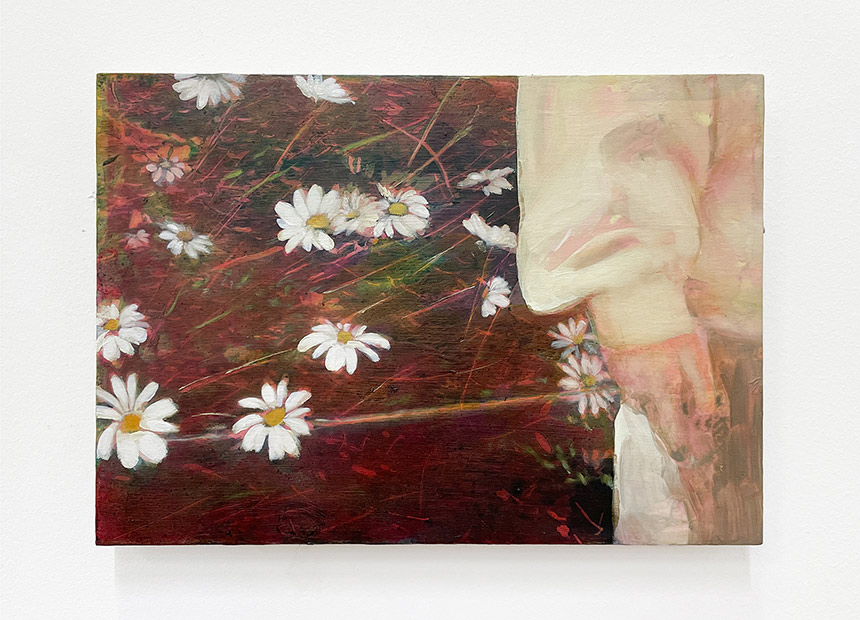
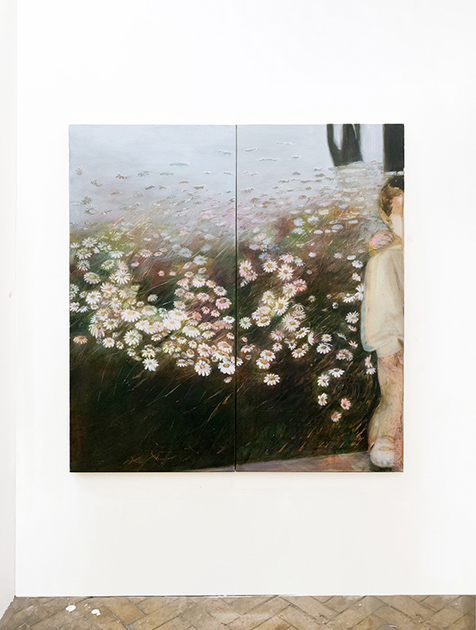
CBP: Your most recent work includes ‘Daisies’ a diptych of a close-up of the wildflowers and children cropped out of the image. Its companion diptych ‘Common Ground’ presents a larger scale zoomed out version, revealing the daisy field to be an interior backdrop with a child stood in front of it. There is another hand mysteriously placed on the cropped child’s shoulder. There are several tantalising triggers of ambiguity and interpretation tied in with the notion of restaging and stepping out of a scene. Can you reveal something about these works?
SR: I’m glad the works have been interpreted in that way because it’s important to me that they remain open and my process of layering here also lends itself to that. I’m also interested in how viewers construct meaning through ambiguity, shifts in scale, and changes in perspective.
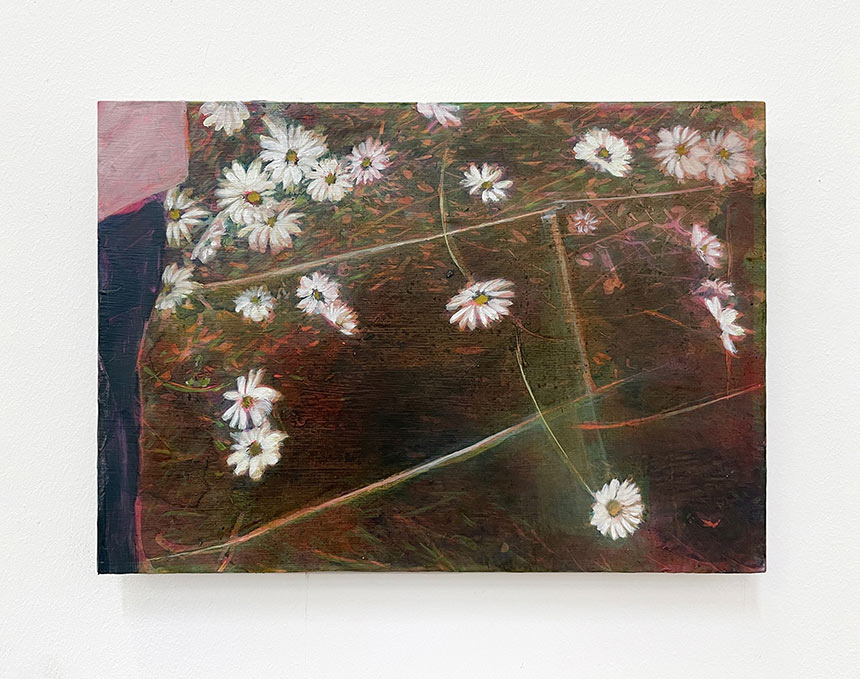
Daisies and Common Ground are essentially two versions of the same image. I wanted to explore how cropping, enlargement, and repetition could completely alter the reading of a scene. In Daisies, the close framing and oversized flowers create a sense of intimacy and suspension, while the diptych structure introduces repetition and comparison – maybe raising questions around time, memory, and whether we are looking at the same moment in time or some other version of it.
In Common Ground, the wider view destabilises that original reading by revealing a flurry of daisies surrounding a life-size child positioned at the edge of the frame. I was interested in the slippage here in a larger scale – how this image could relate to the viewer; how it could feel both intimate and displaced at the same time. The hand resting on the child’s shoulder introduces another unresolved detail within the composition, suggesting there is more occurring beyond what the viewer can fully see.
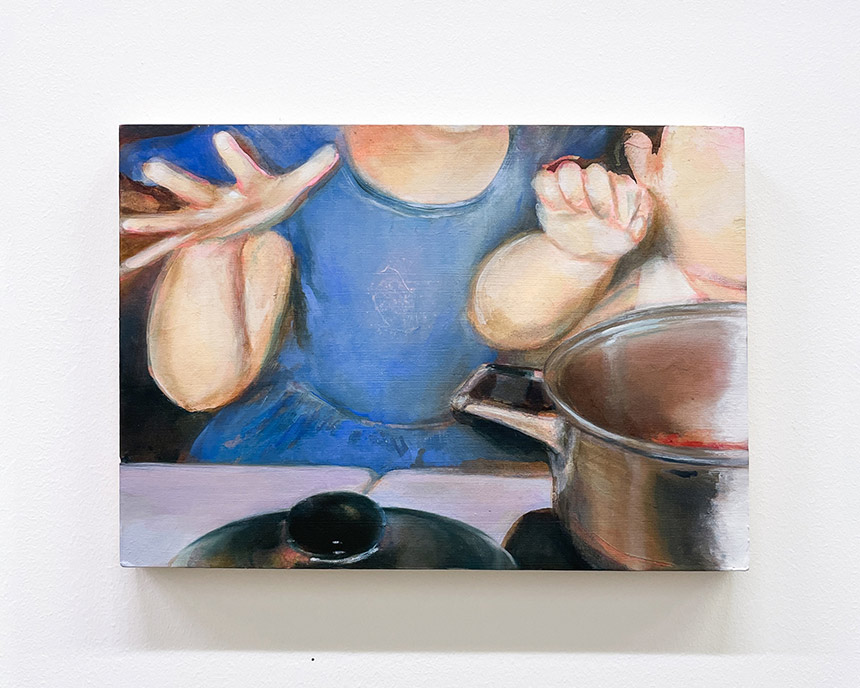
CBP: The 2025 series ‘Aromatics’ depicts cropped close ups of children playing at cooking with an adultness that reminds me of Freud’s concept of ‘Transference’ -childhood play mimicking adult rituals. Is there a particular reference or memory associated with this series?
SR: I wasn’t consciously thinking about Freud’s idea of transference while making the work, although I was amused by this detail depicting children collectively engaged in what appears to be an adult ritual. In the original photographs, the children seem to be genuinely preparing food together rather than pretending, and other images from the same event suggest they were being taught collectively through observation as well.
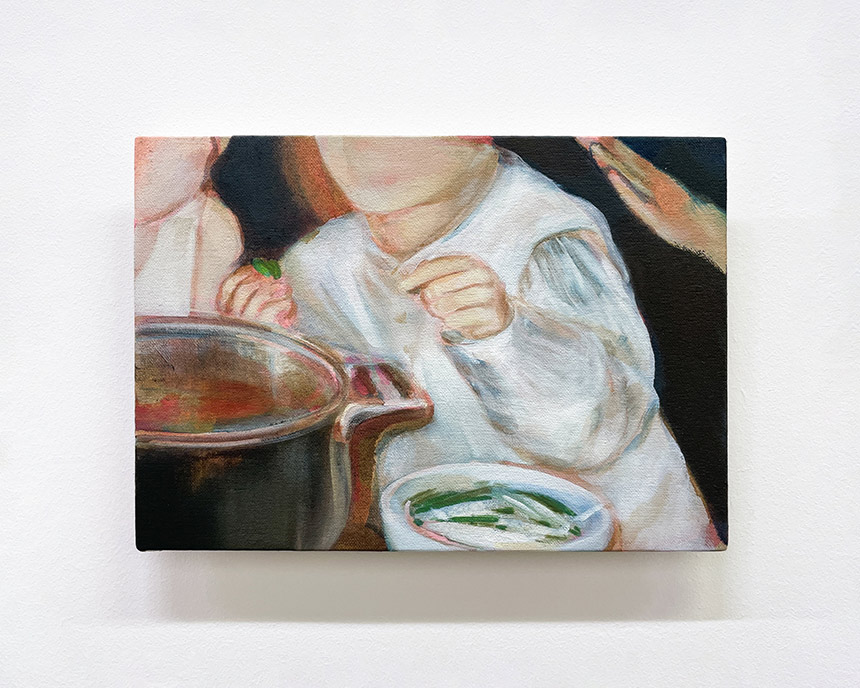
What interested me was how the cropped compositions begin to shift the emotional reading of those moments. The closer the image becomes, the more it generates the unusual – encouraging questions rather than answers.
Although I don’t explicitly remember the event itself – there are gestures, textures, and sensations within the images that feel strangely familiar to me. I became interested in moments of dexterity, concentration, curiosity, and shared attention: hands gathering around a surface, bodies moving together, the heat, smell and atmosphere surrounding the act of cooking.
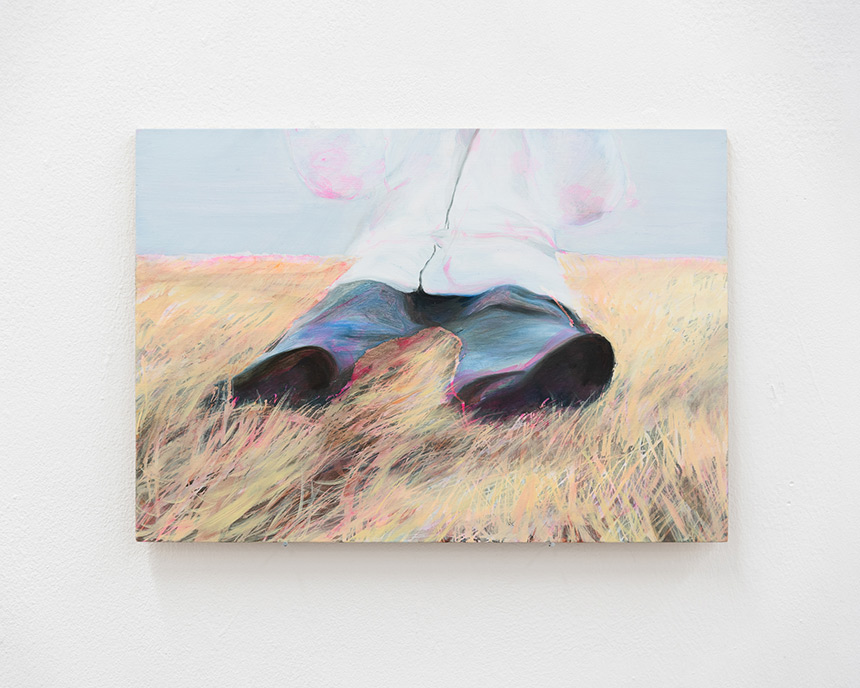
CBP: You predominantly work on a small scale. I saw your work in Contemporary British Painting shortlist exhibition at Yorkshire Art Space in 2024 and was pulled in by its intimate, enigmatic qualities. How to you consider scale as an exploration of your ideas and an approach to painting?
SR: Scale is something I use deliberately to guide the viewer physically into the work. Scale can amplify the fragmented but tantalising details that lure you into a painting. I’ve always been interested in creating an intimate viewing experience – paintings that require close looking and a kind of slowed attention. Because many of the source images originate from small handheld photographs, the scale retains a bodily relationship to those objects. I like that the viewer has to move closer, almost entering the painting quietly rather than encountering it at spectacle scale.
For me, small paintings mirror the fragility and privacy of memory itself. Compression can intensify emotional charge, and subtle shifts in surface, touch, and atmosphere become more noticeable at that scale. I think the works operate almost like keepsakes, fragments, or relics.
At the same time, in my more recent series I have played with expanding the work spatially and compositionally. Receiving the inaugural Judith Tucker Memorial Award coinciding with my residency at Standpoint in 2025 gave me the opportunity to experiment more with scale and installation, which has started opening new possibilities in the practice.
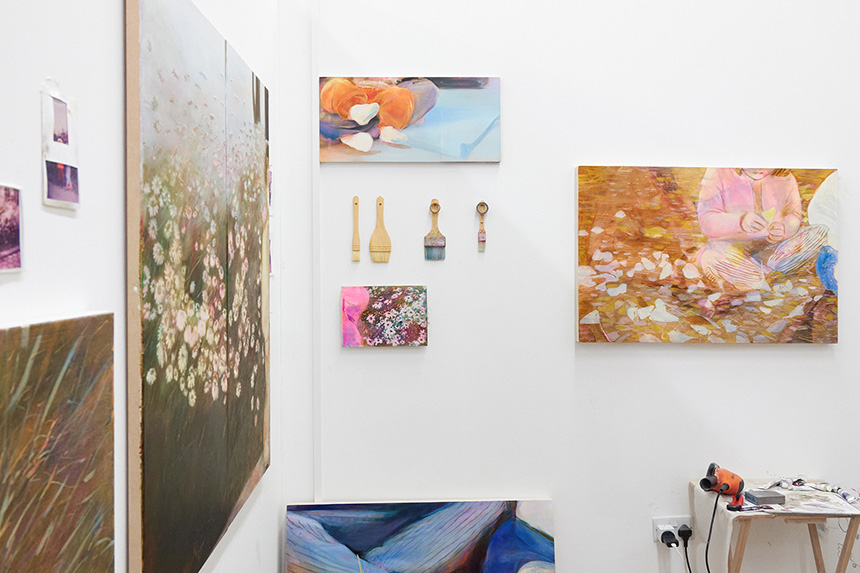
CBP: Can you describe a typical day or ritual in your studio?
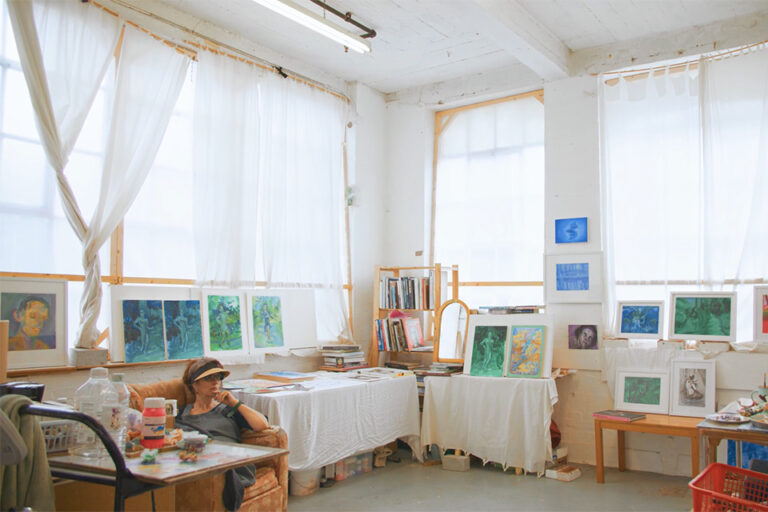
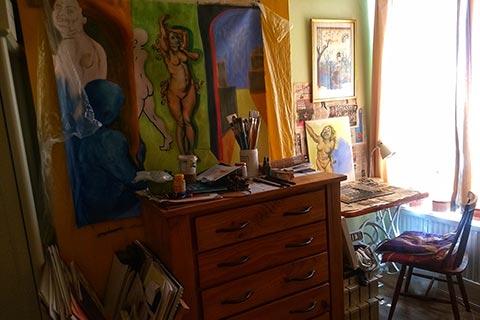
SR: My studio days usually begin quite slowly. I’ll make a cup of tea or coffee and spend time sitting with images, sketchbooks, objects, notes, or photographs I’ve collected during the week. I normally pin things to the wall or spread them across the floor before I begin painting.
A lot of my process involves looking, rearranging, editing, and waiting for certain connections or tensions between images to emerge. I usually work across multiple paintings at once, moving between sketching, masking, wiping back paint, or building thin layers gradually over time.
The studio becomes a kind of space of accumulation and testing rather than somewhere I arrive with a fixed plan. Some days involve a lot of activity and painting into the night, while others are more observational or reflective involving loose notes and lists. Sometimes I listen to podcasts or music, but when things are difficult painting-wise – I prefer the quiet.
Sophia Rosenthal completed her MA Fine Art, City & Guilds London Art School in 2024 and was a shortlisted finalist in the Contemporary British Painting Prize in the same year, where she received the inaugural Judith Tucker Memorial Award.
Her forthcoming solo show at Blyth Gallery, Imperial College London will be in 2027. Forthcoming group shows later in 2026 feature at New Platform Art x Clyde & Co and Macfarlanes, London
Recent exhibitions, 2026; ‘Between Lunch and Something Else, Galerie C, Paris. 2025; ‘Golden Hour’, (solo show), Standpoint Gallery, London. ‘For Something, For Someone’, Katie Lindsay Gallery, Northern Ireland, Brieze, COAG x The Koppel Project, London , The Muse Gallery Residency Shortlist, Group Show, London, GAZAGAZAGAZA, a fundraiser show for Medical Aid Palestine, London.
https://www.sophiaxrosenthal.com
Instagram: @sophiaxrosenthal