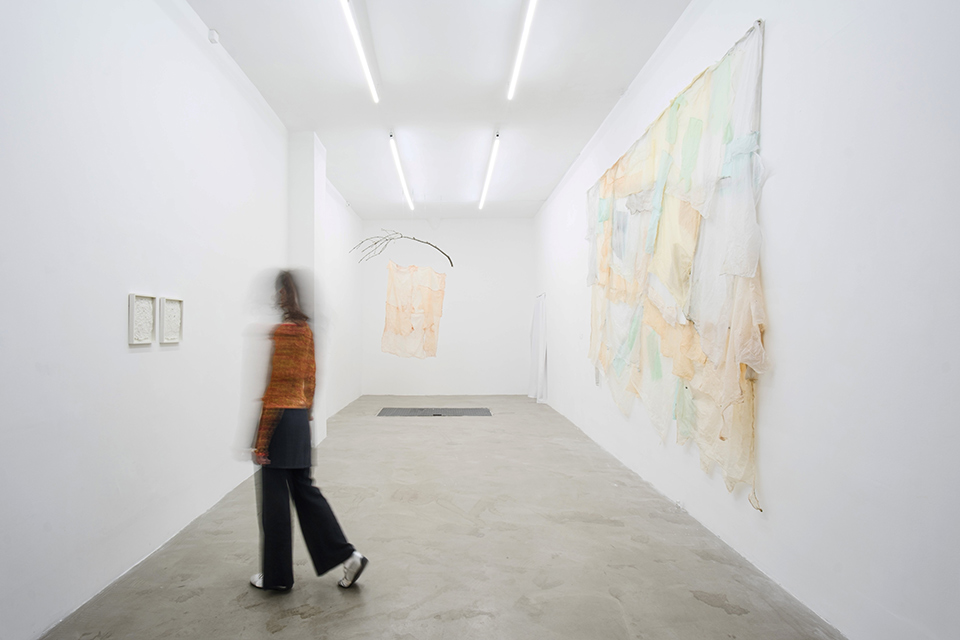
Liz Elton: Artist of the Month
Artist of the Month April 2026:
Liz Elton, selected and interviewed by Paul Newman for CBP.
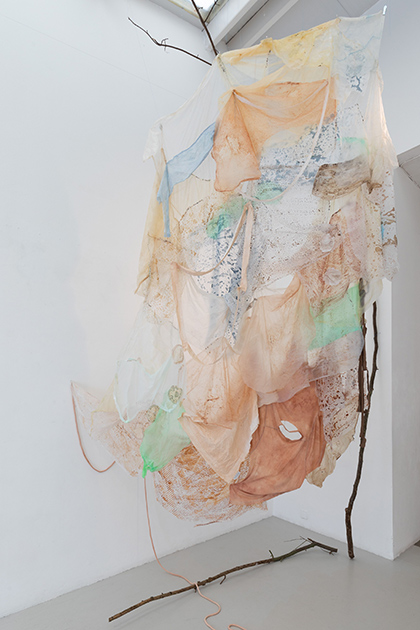
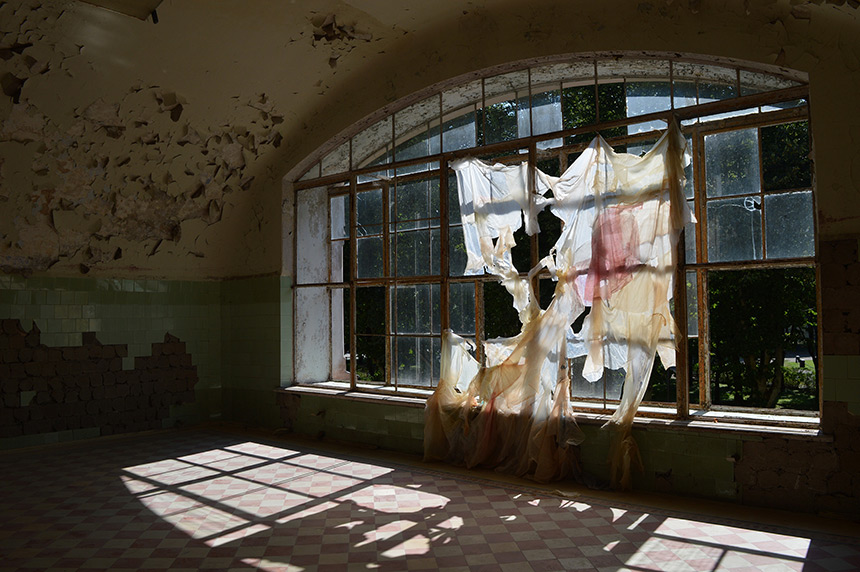
Liz Elton’s practice considers issues of waste, compost and the recycling of matter. She explores loss and grief; potential and hope; nourishment and care; environment and temporality. Her work is grounded in landscape and still life painting and she employs a wide range of media, from photography, video and print to large-scale sculptural installation.
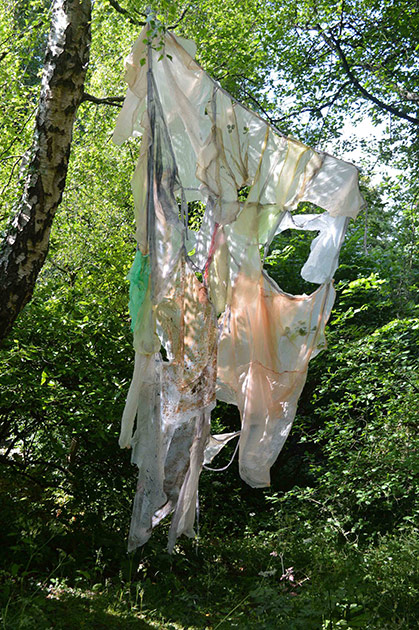
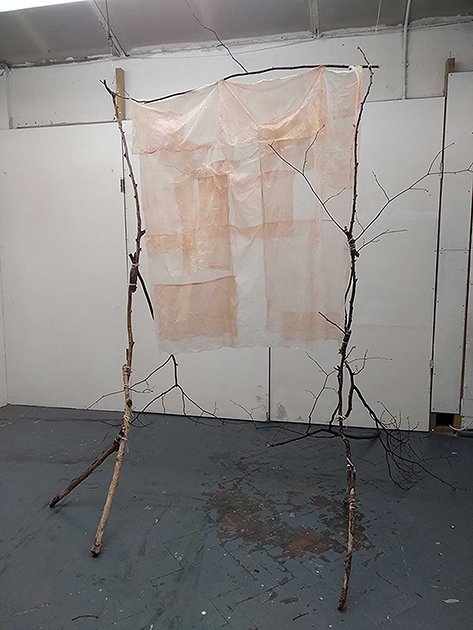
Her installations are often site-specific and include the innovative use of compostable materials such as bioplastic grounds which are loosely sewn together with silk, coloured with kitchen waste and water miscible paints. While the work will naturally decay and decompose over time it is often embedded with soil and seeds of medicinal plants, vegetables or cover crops suggesting growth, nurture and the potential for new life.text
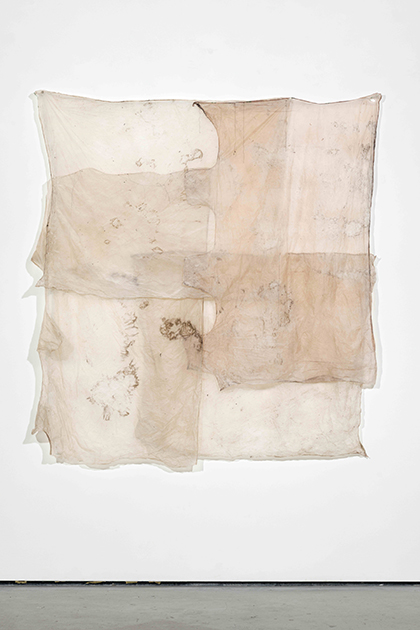
CBP: You create ephemeral works constructed of cornstarch bags and natural food waste dyes that embody painting and speak of natural, environmental themes and ideas around time and entropy. Where did your journey start with this body of work? Were you a painter working with traditional mediums who made an intuitive, conscious switch to your current approach? Or have you always been an interdisciplinary artist that identifies with the aesthetics and form of painting?
LE: I’d say it was a gentle intuitive slide rather than a conscious switch. My love of painting is long standing. I studied history of art, focusing on 18th and 19th century European painting when I first left school, and went on to a degree in painting at Wimbledon when I returned to education. I was painting large works with absences and left over gestural marks, attempting to capture a sense of potential in the overlooked and rejected. This work moved on to painting on clear grounds and taking the work outside so that it deteriorated before returning to the studio to assess the remains. I also began using food waste recycling bags, my own kitchen waste, and seeds, trying to work with the cycle of life and death in one place and to capture a sense of simultaneous making and unmaking.
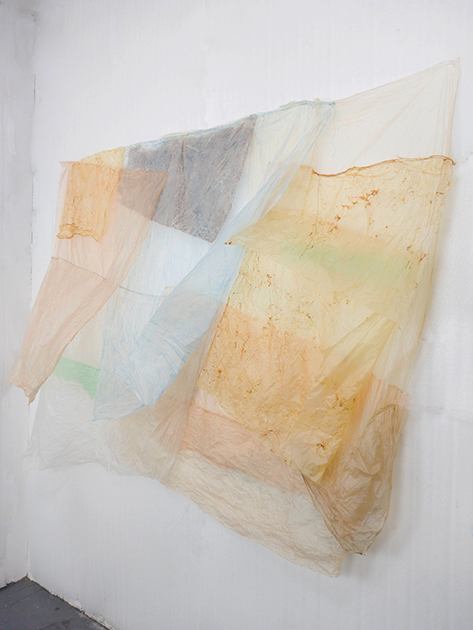
CBP: The notion of temporality, impermanence of colour and material creates a narrative of anxiety in relation to painting. This is based on the idea that painting is concerned so heavily with technical preservation – preparing grounds, using light fast pigments and ensuring permanent displays, storing and archiving of work. You also produce permanent prints of your ephemeral works, as well as a series of archival pigment prints of kitchen food waste influenced by still life Vanitas painting and their framing. Can you talk about your relationship with temporality and permanence with your range of production methods and dialogue with histories of painting?
LE: My narrative is prompted more by anxiety relating to environmental issues rather than anxiety about painting. I find it hard to put things into the world, to make heavy things that need transport and storage. I suppose I have an ambivalence or resistance towards permanence. The materials I use often speak to small repetitive acts of domesticity, and also urgent environmental issues such as soil exhaustion and food waste. Prints may act as a memory of work that continues to change. The images of the contents of my kitchen compost bin allude to 17th century painting from the Netherlands, playing with ideas around memento mori and vanitas, waste and value.
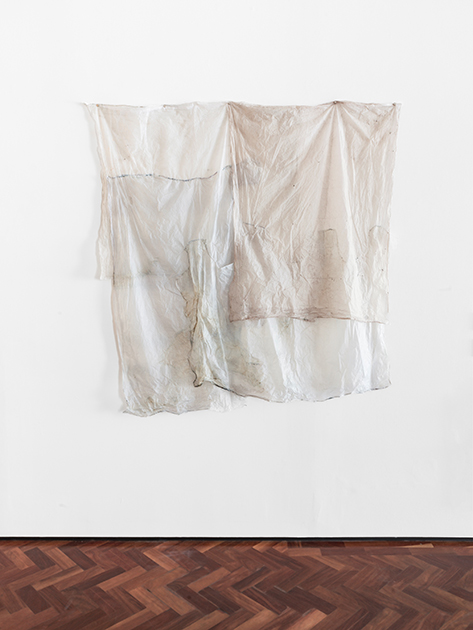
CBP: In the age of Anthropocene and environmental pressure and anxiety, do you consider your work as a contemplation on finding new meaning with organic material and matter? And can you say something about the relationship between the ritual of making the work, its form and contemplation of it by the viewer?
LE: I try to make work with a light touch, using light, often abject materials that embody a sense of ephemerality, methodically hand stitching with silk thread. Colours may come from the waste from my own kitchen, or from foraged materials that are available seasonally, and I embed seeds in the work, often from plants with a relevance to the narrative. So there are rhythms in the process. My large works move gently as the air moves around them, so might suggest the movement of tides or breathing bodies and I think that can make a contemplative space where time seems to slow down. As to whether I discover new meanings is perhaps for the viewer to decide, and I wouldn’t want to dictate or close down interpretations.
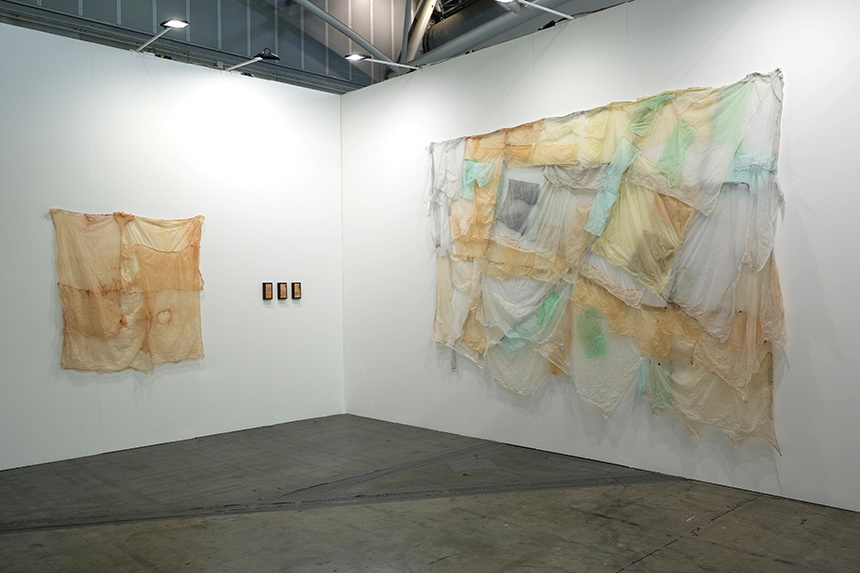
CBP: Annie Albers’ 1965 text ‘On Weaving’ discusses our need to create order with geometry in the natural world, as an example seeing field divisions from the aerial perspective of a plane for the first time. You discussed a similar idea in the geometric construction of your works, and what they allude to. Can you discuss this and the notion of order and control in your work in relation to the nature of the materials you work with?
LE: I think a lot about grief, both personal and environmental, and, given the inevitable disintegration of my work, have talked in the past about letting go, only to be countered by a viewer who told me he thought I was trying to hold on. I think there’s truth in both and I’m suspended somewhere in between. I am interested in a position between a desire to create order, and acceptance of an inevitable chaotic state as all material continues on its universal recycling journey. Some of my work references views of the earth from the air (although I use other images such as my own skin), and I often think of Hito Steyerl’s essay ‘In Free Fall’ in which she discusses our loss of sight of a horizon. I find her thoughts helpful in considering narratives of disconnection.
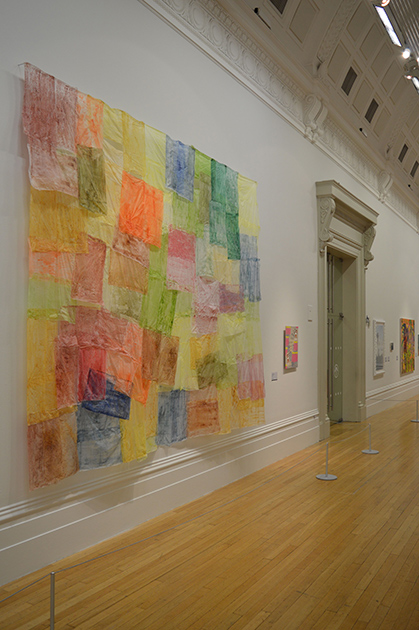
CBP: What’s involved in the making process of preparing the grounds and piecing the work together?
LE: The preparation of material and composition of large work is a process of discovery and often led by the materials I use. Marks may be arrived at by chance, leaving plant matter in the pots of colour, splashing, colour collecting in folds. I might start with a reference, maybe a map, a painting or a narrative, but don’t sketch out a plan and then execute it. I follow a very physical process of arranging pieces of material on a wall. I stitch them together, standing on a step ladder much of the time, which can be exhausting. Often I make watercolour sketches of the work as it progresses, which helps me to distill my thoughts.
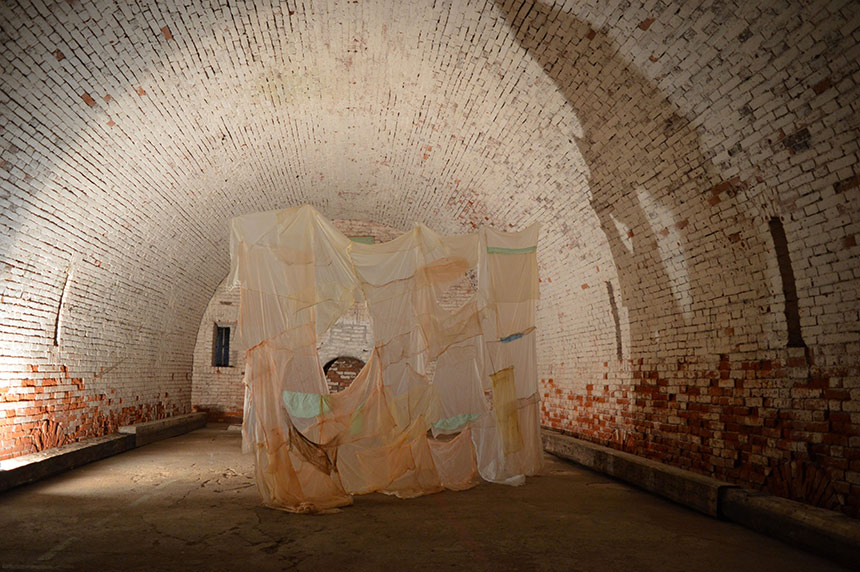
CBP: How do you approach the ‘alchemy’ of making colour from organic matter in relation to colour mixing, the palette and the act of painting?
LE: I find colour making kind of miraculous, and I enjoy not knowing what I’m going to get, although it can be frustrating as browns, yellows and oranges are easier to achieve than blues and greens, particularly as I tend to use kitchen waste. I enjoy the alchemy of adding iron or copper to plant colours and the immediate change this produces, and also the language – copper brightens, iron saddens. A beautiful green can be made from carrot tops with little copper. I’m interested in the science behind the creation of natural plant colours, but my work tends to be led by the results of a process I can’t control. I can’t tell how the pigment is going to adhere to the surface of the material – sometimes blotches occur, other times I achieve an even colour, which I don’t necessarily want.
Adaptable Matter, Bound, 200cm x 300cm, 2025 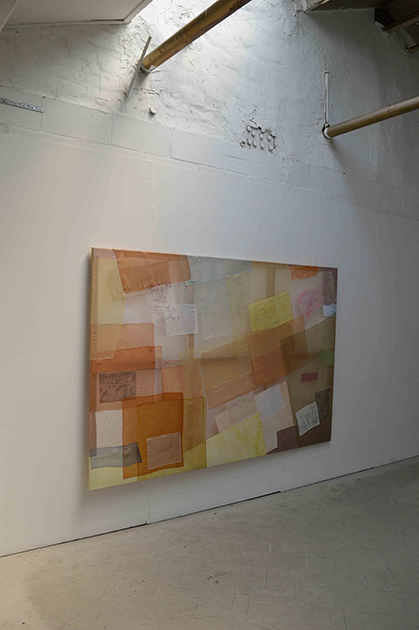
Work Made for Hospital Rooms & Kent & Medway NHS Trust, silk, fabric scraps & household textiles coloured with kitchen waste & watercolours, digital prints on silk, reused stretcher, 150cm x 220cm, 2023
CBP: Can you discuss the rituals for your making processes in the locations where you make your work, the home, the studio and the landscape?
LE: My practice spans my home and studio, and walking between them offers great thinking time as the rhythm of walking lets ideas surface and problems resolve. If I’m at home, I’ll have to start the day standing outside, seeing what’s happening, listening to the birds and checking on the compost. When I’m hanging work in the landscape I like to spend some time alone, considering the site. A few moments of calm help as there’s only so much I can do to control the work given changing conditions as the sun moves and weather alters.
CBP: Finally, can you talk further about the concept and construction of your series of kitchen food waste archival prints inspired by still life Vanitas painting. I’m reminded of Sam Taylor Wood’s stop motion films of still lives quoting this genre of painting in the exploration of themes of permanence, decay and time.
LE: My compost bin prints began in lockdown when I couldn’t go to the studio and felt thrown into reverse gear. I’d been focusing on trying to grow things, using the compost from a bin behind my house, putting excess plants out on the doorstep for people to take. I’d been using some red onions and looked into my kitchen waste bin and saw a painting, so I photographed it, and after that kept seeing paintings in the bin, so I kept photographing. Resonances with wider issues occur, a mouldy orange might suggest a planet, collapsed tulips to the 17th century tulip crisis and the possibility of economic change. The compost bin seems to me to be a place where everything is broken down to become something new, and I find that a hopeful thought.
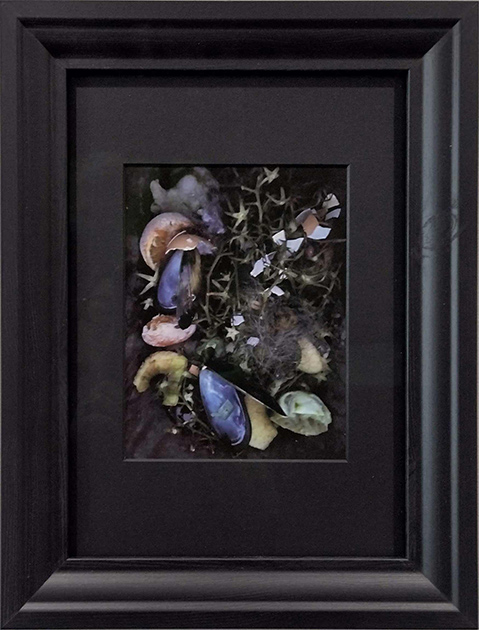
Compost Print 30 Mussel Shells & Vines Like Stars, achival pigment print 14.5cm x 19cm 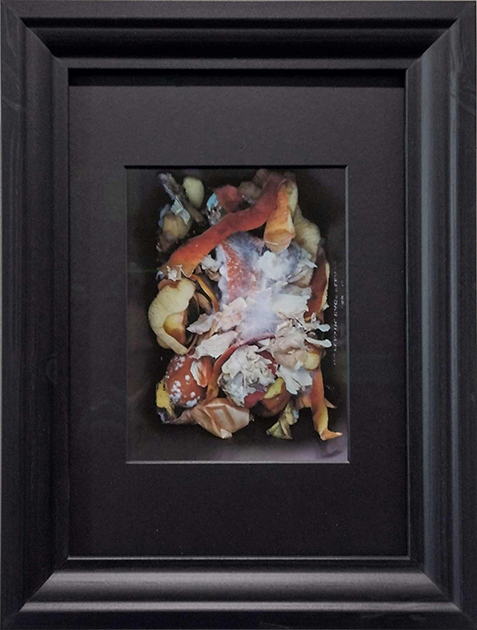
Compost Print 36 Wish, achival pigment print 14.5cm x 19cm
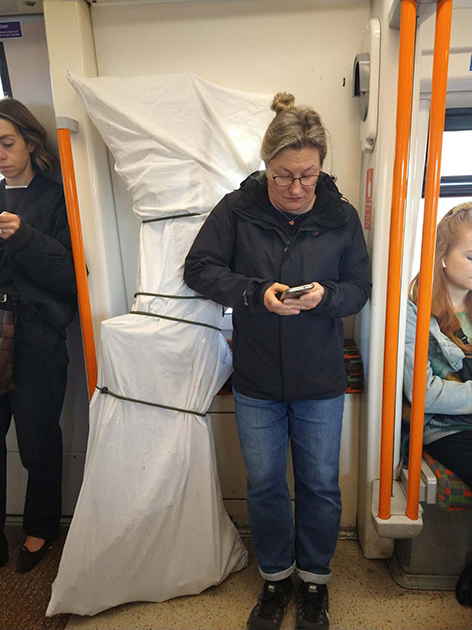
Liz Elton has completed a Hospital Rooms commission, is the recipient of a Mark Rothko Memorial Trust Artist in Residence Award and has been shortlisted for the John Moores three times. She has been artist in residence at Florence Trust, Groundswell Regenerative Farming Festival, and on the Isle of Eigg at the Bothy Project, supported by Winsor and Newton.
Recent shows include ‘Cure3’ 2025 (in support of cure Parkinson’s), Bonhams, London, ‘Market of Desire’, Cable Depot, Sofia, Bulgaria, ‘Landscape Painting Now’, Messums, Cork Street, London, Hospital Rooms Digital Art School Installation and Auction, Hauser and Wirth, Savile Row, London, and ‘Life Boat’, APT, Deptford.
Solo shows include ‘Takeaway’, Punta Gallery and Cable-Depot, Sofia, Bulgaria, ‘Work in Progress’, Fitzrovia Gallery, London, ‘Ground, Falling Away’, The Gunpowder Store, Daugavpils Fortress, Rothko Museum, Latvia and ‘Liz Elton’, Art Centre, Harris, Outer Hebrides.
Instagram: @liz_elton
https://www.lizelton.com/