Katie Pratt: Artist of the Month
Artist of the Month November 2026:
Katie Pratt, selected and interviewed by Paul Newman for CBP.
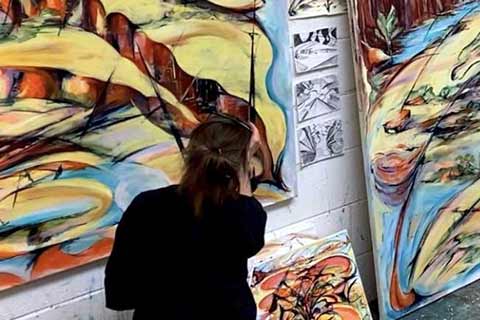
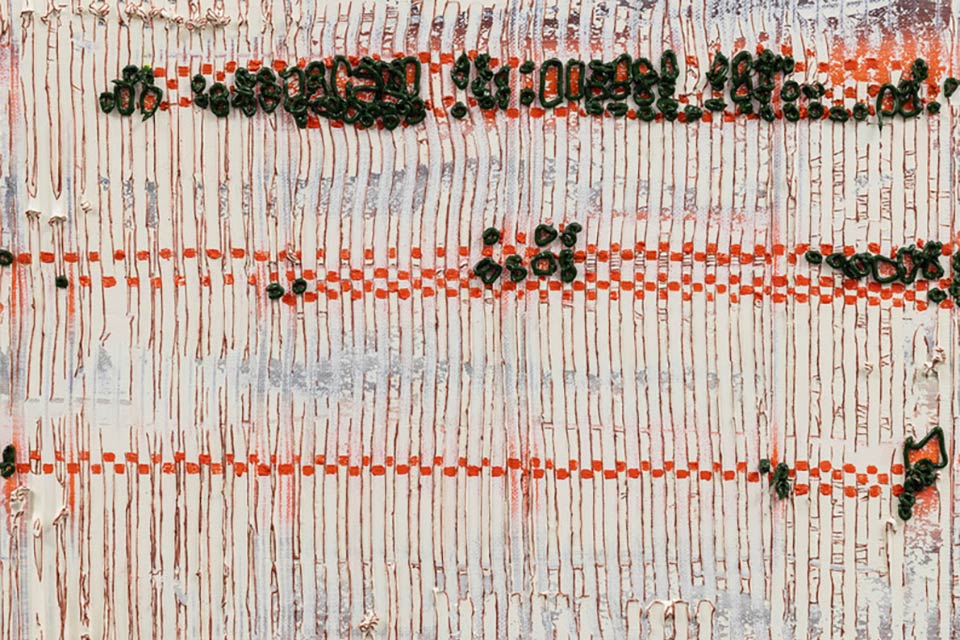
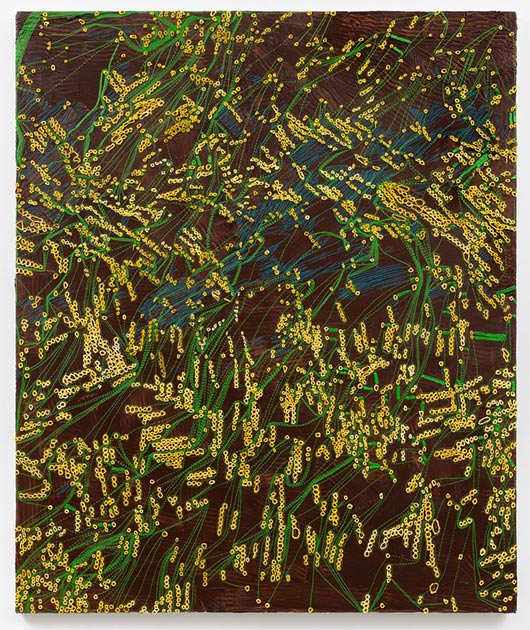
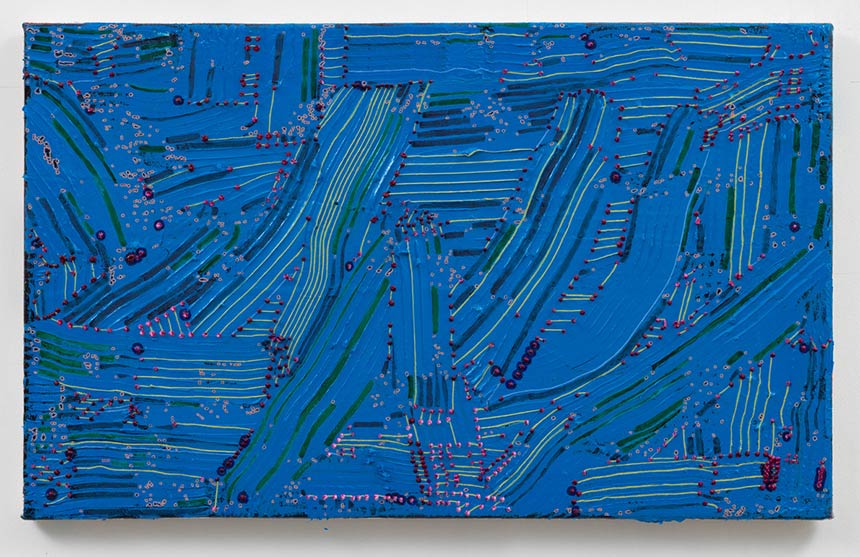
Katie Pratt’s paintings generate emergent patterns that emanate from chaotic beginnings and then – through the painting process – develop an idiosyncratic internal logic. Systems are designed in response to chance and gestural features in the painted ground. Each painting develops its own set of rules that accumulate over time and give rise to contradictions and competing structures. This accretion of regulation adds complexity to the imagery, reflecting the organic intricacy of human organisation, both socially and politically.
CBP: Your paintings present complex systems that explore the nature of painting itself as well as suggesting scientific imagery, mapping and other schematics. Can you talk about your starting points and the first gestures?
KP: Complex systems are an inspiration: the eventual outcome of each painting represents a metaphor for my experiences of the complexity I notice throughout my environment. The process involves many successive interventions that respond to one another and interact in an irreproducible manner. The nature of complexity is that the same conditions produce different results each time, so I cannot visualise the paintings in advance nor during the process – that’s part of my motivation for painting them. The process involves making a visual statement and then devising a programmatic response that is implemented multiple times, so I like to begin impulsively and swiftly so that I have something to react to. I contemplate the other works in the series or the other paintings in the studio at the time and think about complimentary marks and surfaces as well as colours that will both contrast and sit well in a series. I also think about the kind of scenario I hope to investigate in terms of the quality of the ground, whether it’s a figure /ground or more of a field that I’ll be working into. I’d be naive to declare the paintings actual complex systems such as exist in the wider world; ecosystems, the economy, the weather system, eg. There are definite gaps in my systematic approach – but that is the difference between a human painter and an AI.
CBP: Are there any key moments in your journey as a painter that have been turning points for the way you make your paintings, or has it been a slow indefinable evolution?
KP: A bit of both, probably- in a matter of degrees. I have been interested in systems and process painting my entire professional career whereas some artists experience a big subject matter shift or revolution in their process. I tend to persist with a problem and pursue resolution more profoundly now than earlier in my career. Consequently, I have reworked old paintings that I now consider unresolved. There are times when an experience – such as travel or an exhibition makes a massive impact on me – whether inadvertently or consciously. The Lucio Fontana exhibition at the Hayward in 2000 was a case in point, as was Action, Gesture, Paint at theWhitechapel in 2023.
Otherwise, in addition to seeking new ways of looking at things or continually addressing aspects of my painting that I feel need attention, a hiatus such as a studio disruption can make the natural evolution of your work move in steps rather than gradients.
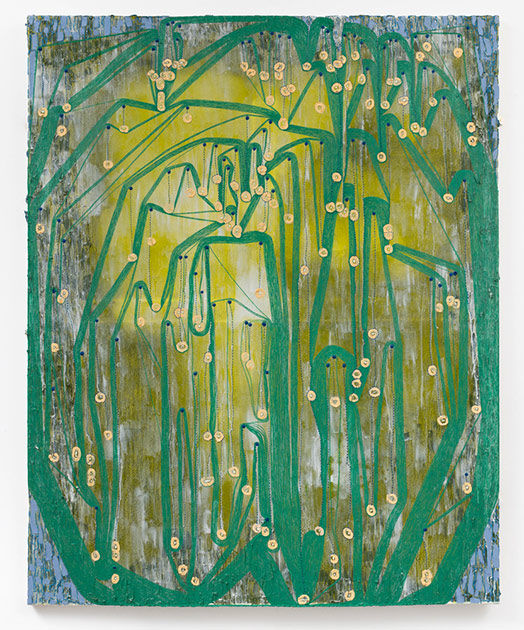
CBP: Your paintings generate a discourse of disrupted and fractured systems, holding together with a sense of incomplete completeness. Can you talk about notions of systems and rules made and rules broken in your paintings?
KP: The rules themselves are prosaic – circling reoccurring lumps and dimples and linking them together. It’s partly an organisational strategy and partly an ideology to always apply the same rules to the same conditions. Pursuing successive rules becomes systematic and it’s the interconnection between systems that introduces complexity.
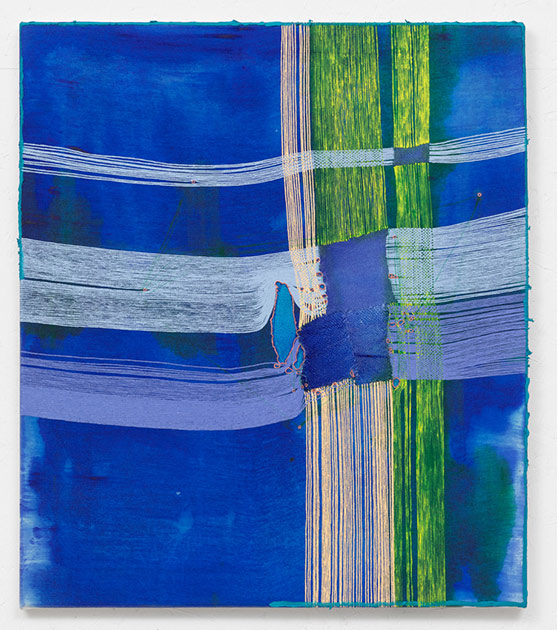
Ultimately, it’s an expression of my state of mind and an exploration of how I manage information and learning. It’s human nature to look for patterns and order in a disordered environment, but my focus maybe has a bespoke wavelength in terms of my perceiving a large expanse of paint as a composite of details rather than as a holistic form or composition, and in perceiving chaos where maybe another artist would simply overpaint and build a narrative. I feel compelled to organise the materiality of the actual paint that forms the ground and draw patterns out of it.
This process establishes a programme of work so once I know where my attention lies, I spend less studio time wondering what to paint and just pick up the brush and get going.
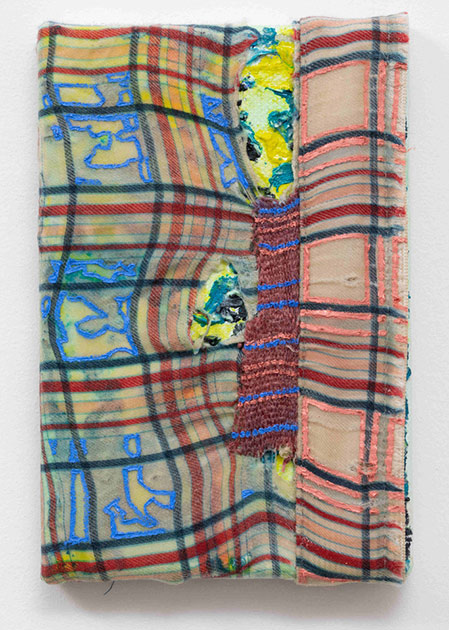
CBP: There is a strong sense of serious play of open-ended possibilities in your paintings. I sense you can see several possible steps ahead, like an elite snooker player who can see several shots ahead and potential outcomes. Can you discuss the dilemma of decision making in your painting?
KP: Intentions as to the next phase, or phases, of the painting may suggest themselves to me before I get there. But actually I work blind and cannot foresee what picture will emerge. The imagery is determined in the abstract by the algorithms I programme rather than by a planned vision. I find this the most exciting element of painting and really enjoy watching the painting reveal itself in a new way each time. The big decisions are specifying the rules to myself and choosing paint. Once I’ve done that, the decisions are so small that I barely notice I’m engaging with them.
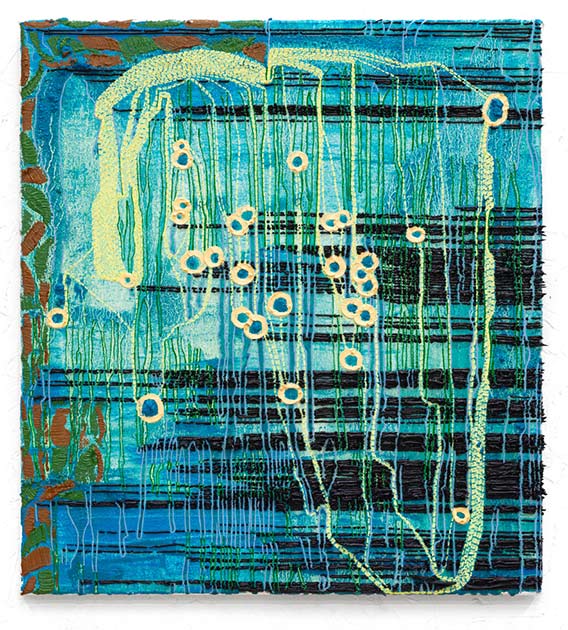
CBP: You have discussed many influences on the form and figuration in your painting, including the scientific. I have a friend Ian Andrews who makes complex layered experimental drawing as installation, which is inspired by his research and collaboration with the Particle Physics department at Birmingham University. He uses his learned knowledge in this field to generate frameworks and rules for his drawing practice. However, his work isn’t illustrating these theories like scientific diagrams, it is it’s also its own autonomous thing with art history references in abstraction and cubism too. It’s like a conversational relationship between the two fields. I wonder whether you identify with this, or have your own take on the relationship with your painting and your research sources?
KP: Yes – thanks for the reference. You describe really clearly the way abstract thinkers might approach making: the visual transcription of a concept rather than something experiential or tangibly present. The concept itself is not inherently visual, or inherently particle physics, or anything else: it’s a set of conditions that can be applied across fields to various scenarios and in varying forms. One of the qualities of particle physics as I understand it is the chasm between physical matter as humans experience it and how it apparently exists on a nano-level.
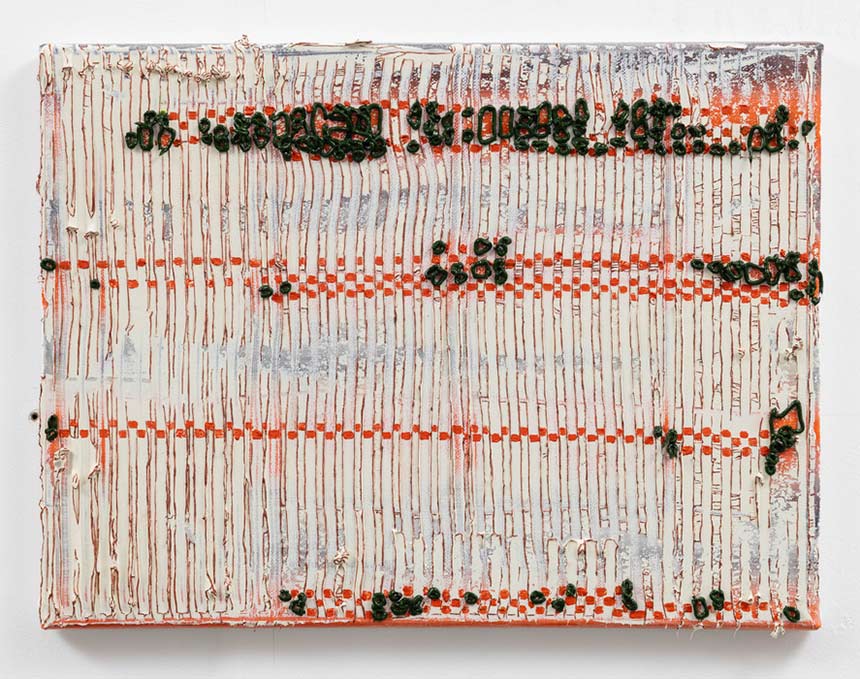
CBP: You mentioned in a previous interview as an art student near the British Museum being inspired by ancient manuscripts on stone. ‘Palimpsest’ is a term for ancient manuscripts that were rewritten over several times, bearing scars and traces of previous layers and histories. Its concept discussed by other artists in the making of their work such as Helen Marten who constructs complex layered systems in her sculptural installations. Can you identify with this concept with your own work? And do you incorporate much erasure and removing of paint to reveal corrected layers and decisions?
KP: Yes I did my foundation at Central in Holborn and frequently visited the British Museum. The reworking and layering you describe is something that my paintings lack and that I have been working to address. Although there is temporal layering in the paintings, the surface appears locked together in one plane and in that sense, simultaneous, There is a content-driven reason for this: they are process paintings in which showing the workings is the subject matter. However, that fact does not prescribe any particular methodology or paint application. Painter friends and colleagues, John Greenwood and Alice Browne have both mentioned this to me in separate studio visits. I don’t think there’s anything inherently wrong with my approach but I agree that the work would benefit from expanding its breadth in terms of translucency and material consistency in overlaying. So lately I have been thinking about how to adopt the more fluid and blended paint-handling such as I used when I painted from observation, say. What I’m grappling with is how to transcribe the conceptual premise of highlighting barely perceptible detail with precision into a broader variety of formal languages and material consistencies of the paint itself.
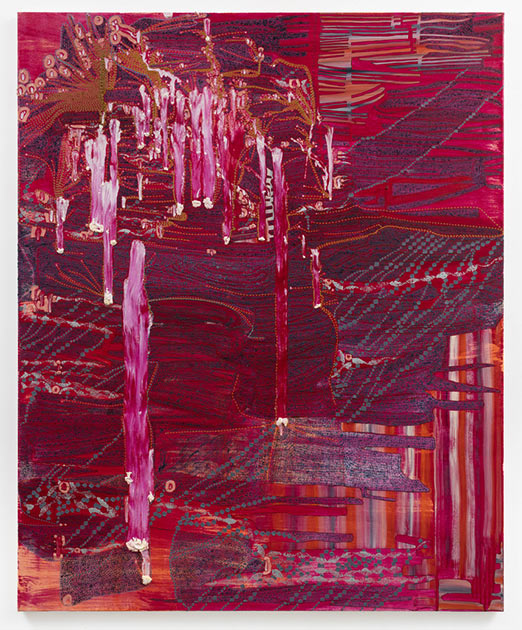
CBP: Can you talk about painting at different speeds and scales of mark making in your work?
KP: I already mentioned that the paintings start fast and then slow down, in general. I am keen to maintain a variety of paces in the work. Sometimes I set up strategies that are really fast and completed very quickly. I think that having alternative beats in different paintings is important.
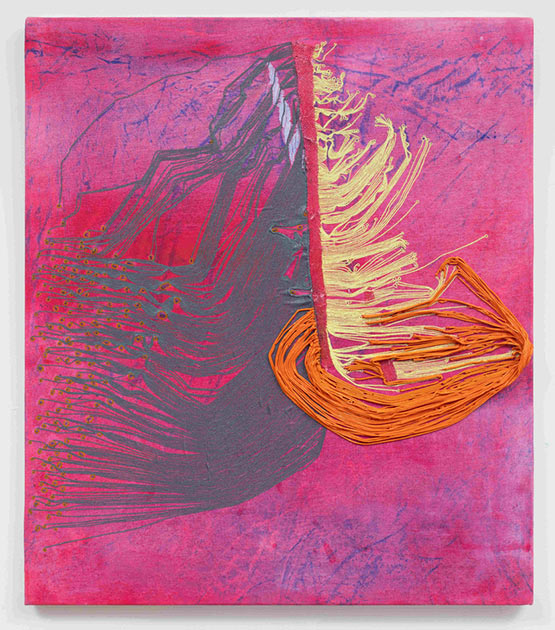
CBP: Is your palette, tools and mediums potentially unlimited, directed according to the journey individual paintings take? Are there any strategies and hooks that you return to, to help define and determine the outcome of a painting?
KP: I’m always aiming to extend my own vernacular and break out of the rigid assumptions and paradigms that it’s so easy to sink into in mid-career. However, I feel it is important to maintain a certain constancy in approach to sustain a practice – to work at the same idea but from a different angle so that there is a depth to the investigation. There is a linguistic rationale to relying on oil on canvas in that it acknowledges my indebtedness to art history in order to communicate.
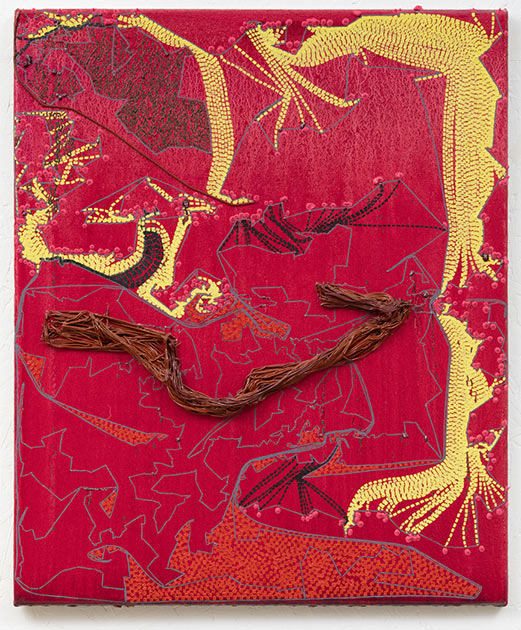
CBP: Can you talk about the approach and decision making in finishing a painting and the notion that you have described as a painting being ‘indeterminate’?
KP: Paintings always finish when a system is complete. I grapple with whether a system is to be the final statement or whether further intervention is needed. This is an intuitive choice like all artists make. You can divert and delay intuition but you can’t dodge it altogether.
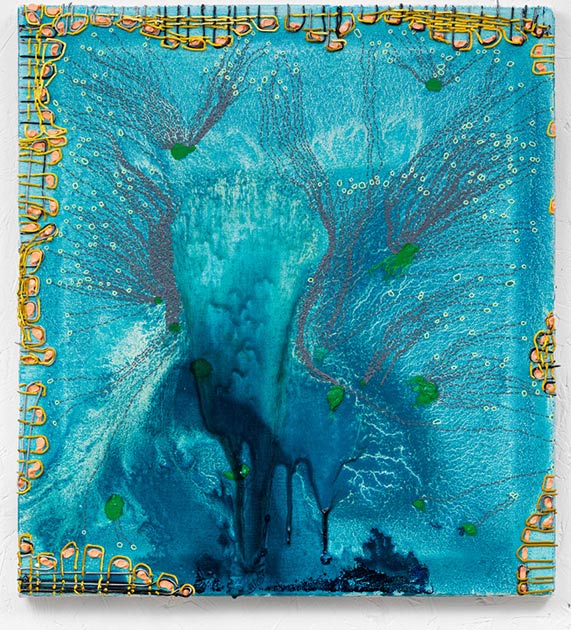
Katie Pratt MA (RCA) (1998) is an abstract painter living in London. Winner of the Jerwood Painting Prize 2001. Recent exhibitions include Analysis, Disruption, System at Stiftung Konzeptuelle Kunst, Soest and Rosie Mullan : Katie Pratt at Kingsgate Project Space London.
In 2021 she curated Autumn Attic at Flowers Gallery. Other notable group exhibitions include Location /Dislocation… at Mark Rothko Center, Daugavpils touring to Dubulti Art Station, Riga, 2020; Patrick Heron, Jonathan Lasker, Katie Pratt at John Hansard Gallery Southampton, 2006; Landscape Confection, curated by Helen Molesworth at Wexner Center for the Arts, Columbus Ohio touring to Contemporary Arts Museum; Houston Texas and Orange County Museum of Art, California 2006.
Solo Exhibitions include at Galerie Peter Zimmermann, 2012 & 2016; Fine Art Society, London, 2012; Kontainer Gallery Los Angeles, 2003, 2005 & 2008; Forum d’Art Contemporain, Sièrre, 2003 and Houldsworth Fine Art London, 2001 & 2003.
https://www.katiepratt.net
Instagram: @katiepratt_artist