Artist of the Month: Marius von Brasch
March 2026:
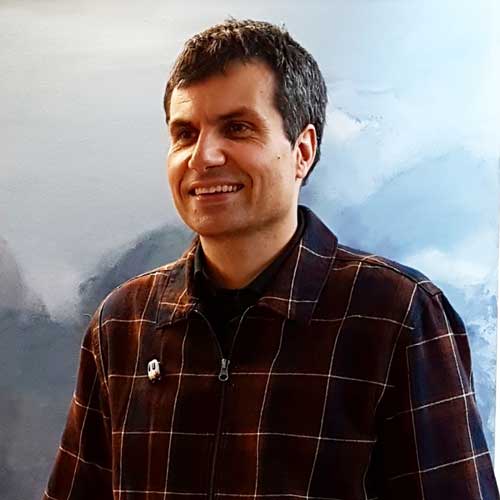
Marius von Brasch, selected and interviewed by Paul Newman for CBP.
Marius von Brasch’s paintings explore transformation, identity, and the inner journeys of change, loss, and renewal. Moving between abstraction and figuration, each work holds memory, emotion, and reflection, inviting viewers to witness and engage with their own personal evolution.
‘For a long time, I have been captivated by both the potential and the fact of change, transformation and metamorphosis. The often unpredictable outcomes of such developments – abrupt or gradual, chosen or reinforced – can evoke fear as much as new perceptions of life…’
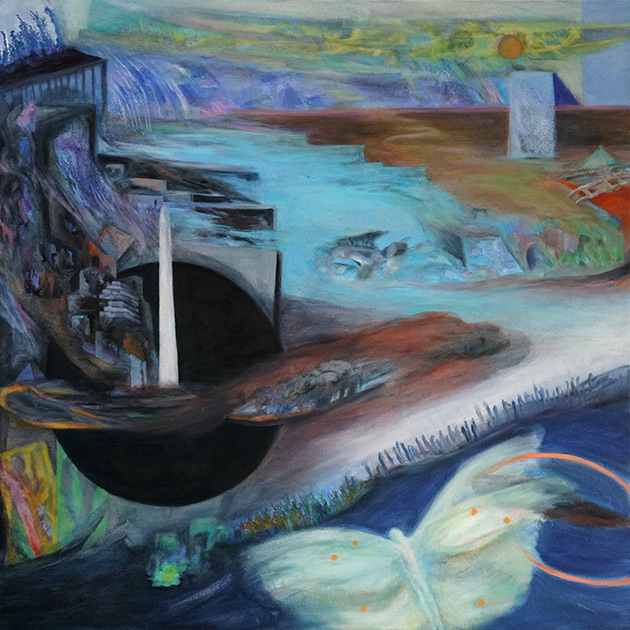
CBP: Your fluid and fractured, dreamlike paintings are representations of landscapes and figures in a state of flux and transformation. You use the term ‘inscapes’ in one of your statements. I identify with this as an approach to naming my own painting, where I’ve used a term ‘interior studies’. Other broad terms are interior worlds and mindscapes. Can you talk about this notion of interiority and the depiction of landscape in your work?
MVB: In my paintings, I aim to understand how I perceive and process reality. I observe and use my own ways of processing to think and make visuals about the fragility and uncertainties associated with the ideas of truth and identity. As I share 99.9% of my DNA with every other human being, I trust that these experiences, processes, and encounters with interiority are relatable; however, the 0.1% allows me also to trust in the particular lens of my own language.
For me, there is no doubt about the significance of intentionally engaging with the powerful work of interiority, which often remains hidden and difficult to grasp, even to ourselves, yet influences all, including political decision-making and our responsibilities towards others. The sudden emergence and disappearance of unpredictable, spontaneous feelings, the filters of memories, trauma, fear, hope, and the events of love and loss are as much part of reality as a growing and dying tree in my garden, the skyline of visual cubes in the distant horizon that shelters thousands of lives and stories, touches, gazes, words, machines and music that appear and fade from my experience or ‘view’.
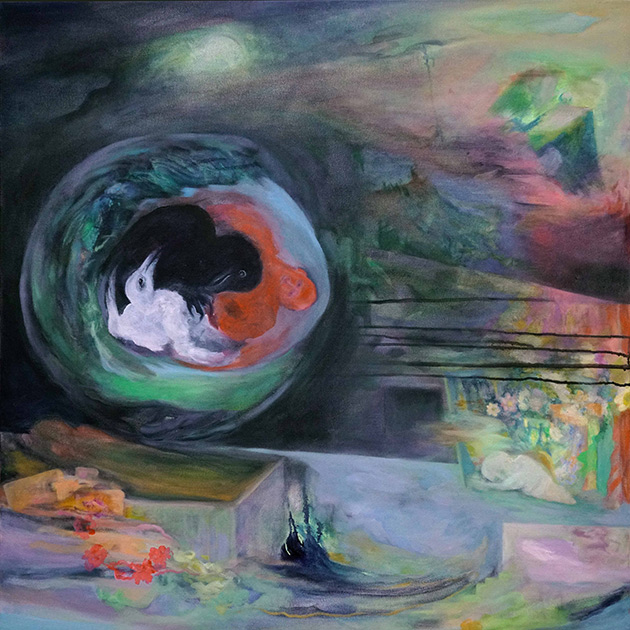
Reflecting on interiority, I find it difficult not to think spatially, or better, in terms of an open space of sensation, feeling, and thinking in the flux of time, which is sometimes called the ‘bodymind’, a perceived unity of fluid perception, which, when I interact with someone else, extends into a third space, forming a temporary, different zone – again, a space, a potential landscape – of interiority. What happens in this zone, – mutual projections, intuitions and insinuations about ‘the other’ – remains most of the time unsaid.
Discovering Nicolas Poussin’s mythological landscapes years ago was a powerful experience and provided me with a model for developing ambiguous landscapes (or ‘inscapes’) and visualising elements of ‘experience’, the passing of time, and the presence of various time layers. The earth-coloured pathways in these Poussin paintings follow curved, snake-like deviations into a distant, often mountainous horizon. The figures on them mark different stages on a journey in time or, when functioning as personage of mythological ideas, which they often do, relate to a time layer out of sync with the contemporary Italian landscape: they are not natural parts of the landscape but belong to imagination or a concept, to making sense of time and change, of being pulled towards something and away from something else; to making sense by involving the right hemisphere of the brain – the realm of myths and dreams.
The historically earlier alchemical illuminations are structured similarly: the alchemical protagonists and symbols hover like a second ‘natural’ layer on the (medieval) contemporary landscape (a superimposed, large and symbolically relevant black or red sun close to the centre of an image, for example, has no effect on how the dwarfed landscape is lit).
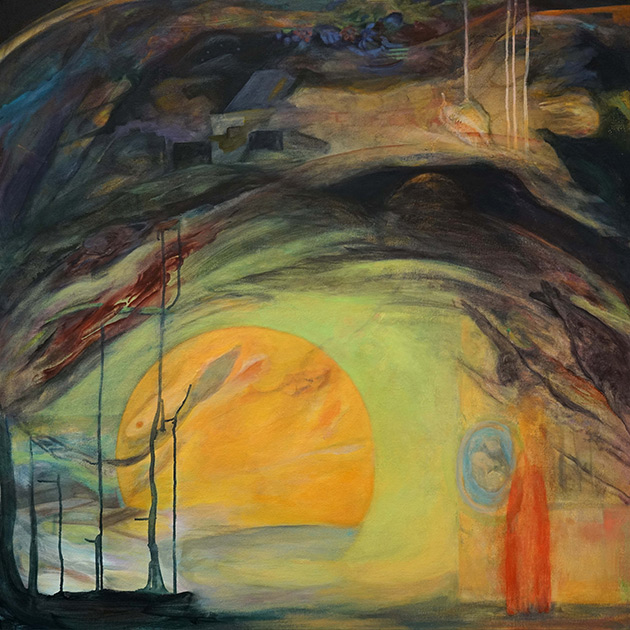
CBP: There’s a compelling push-pull of figure/ground relationships in your work; the paintings feel uncertain and about to shift and change, though they are resolved. Elizabeth Gross in her book ‘Chaos, Territory and Art’ discusses the essential need to create order out of the chaos of nature, through architecture, the window and the frame. And painting broadly reflects this tension. Her example studied is Deleuze’s writing on Frances Bacon. Can you talk about the process of emerging and submerging figuration, architecture and the balance between uncertainty and completion in your work?
MVB: In connection to the crisis of realistic, figurative painting in Modernism, Deleuze distinguishes three broadly conceived modes in which painters deal with ‘chaos’: in abstraction, chaos is transformed into manageable codes; in abstract expressionism extended to and let loose onto the entire painting surface; and negotiated in the ‘figural’, which lets forces, remnants of chaos, work through and into figurative elements, distorts and twists them, thereby making them witnesses to the encounter between painting, painter, materials and forces. I’m very aware that I have been only seriously interested in the latter scenario, because painting came to me in an imperative way, almost as a force from within pressing me to paint and become visible. Life drawing and observational studies, in contrast, have played a subordinate role, supporting my interventions to order, diversify and develop this painterly leaning into ‘chaos’ and also to ‘play’ with it.
However, a discussion about ‘chaos’ and a painterly approach depends entirely on how a painter feels about this notion, as it remains imprecise, another vessel for imagination and projection. What to expect in/from chaos depends on sensitivities, memories and fantasy: is ‘it’ uncanny, overwhelming, haunted by death and inverse, spectral forces – or is it ripe with potential, life force, and virtual emergence, with hidden and alive light?
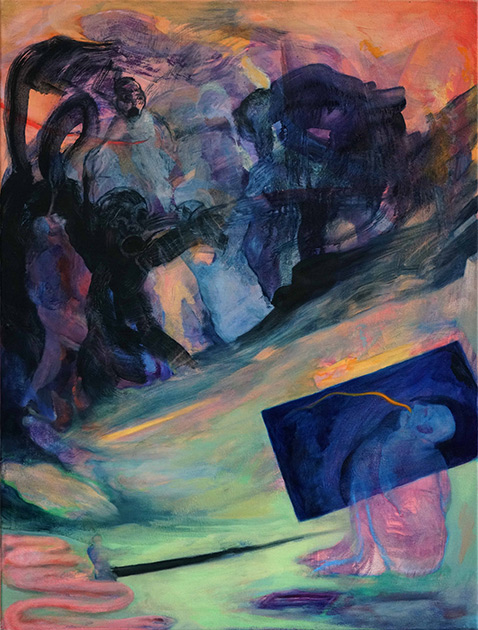
All of these qualities lead back to ‘forces’ that can push either way, to life itself permeating nature, environment and ourselves, and the impossibility to grasp it as an ‘essence’ or a ‘what’. I can only experience it as ‘how’, as a process of becoming in time, dealing with an ‘excessive presence, the identity of an already-there and an always-delayed’, as Deleuze writes in his book on F. Bacon (The Logic of Sensation, Continuum 2003, 36).
The work on a canvas, i.e. the chosen materials, my effort and state of mind, the frame built by the edges of the canvas in front of me, constitute and contribute to the framing of painting as ‘letting’, how Arnaud Villani has put it in his essay The Insistence of the Virtual, ‘oneself act, to let the virtual infuse, without forcing it’ (in P. Gaffney, ed, The Force of the Virtual, 2010, 77). This beautiful, almost a koan, hints at a mutuality or mutual attraction between ‘chaos’ and ‘me/the painter’, at the potential of a painting to become a visible witness of a multi-faceted scenario. It requires my open, active/passive curiosity about something new, and not to fall into the trap of reproducing a cliché.
Working with separate frames or somewhat marked zones within one painting helps integrate a for some reason isolated pocket of memories or associations. Such frames within a frame appear already in illuminations of the early Renaissance, imagery I have worked with and referred to often.
Architectural forms – houses, skyscrapers – offer distinct graphic lines and angles to stabilise the energy I wish to capture or trace. They resist the ‘forces’ visually as shelter and human structure on the one hand, and as somewhat opaque boxes that might contain something unknown on the other. Two observations had an influence on how I use architecture as polarity to flux in a structural sense: some of Poussin’s groups of houses closer to the paintings’ horizons seem to play no role beyond resolving a formal question; then, when I projected a group of zoomed pixels on a painting I worked on, they seemed to merge visually like buildings into it, which I could develop further. For a few years now, such architectural structures, which always refer to human life, have fallen apart in my paintings, torn down and washed away, and I sometimes felt bad, morbid about this. But today I can see that I might have picked up a bigger political and cultural development approaching, a crashing of values, which count(ed) for me.
Most of my painting – entrusting myself to a process that I can’t predict but form and edit – aims to negotiate the frightening aspect of impersonal, individual life-negating forces with the potential of something new, life-affirming. A painting is finished when I feel this balance.
I guess, one of the reasons for this need of balancing (and a tendency to push the energy lines beyond the given frame) has been a queer mistrust of fixed identities, and also poignant experiences of death from early on in my life, the loss of many friends, my parents, and my three brothers, which have only strengthened my appreciation of the uniqueness of people I know or love, of their creativity, of waking up in the morning beside the man I love, being able to take part in what I experience as the miracle of the transience of nature and human life, as twisted, fragile and sad it can be.
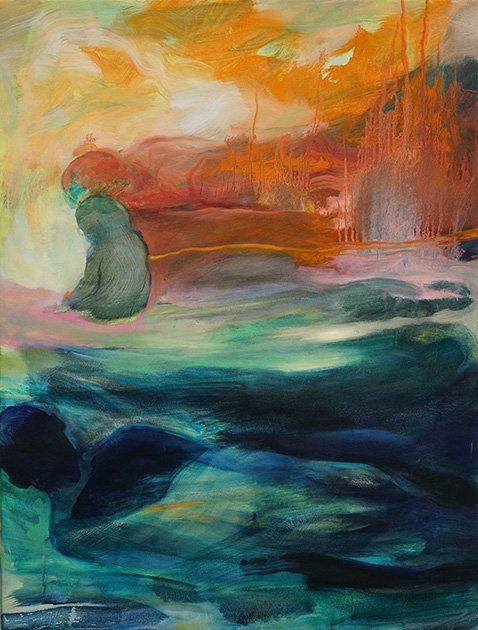
CBP: Holding on to the notion of uncertainty and change, we are perpetually living in troubled times, and life often seems to just get harder and less stable. This is a compelling and wide-scoping human theme to express through painting. Your paintings don’t appear hopeless, and there is a sense of the romantic, perhaps connected to Romantism, and something tangible that isn’t psychologically dark in your painting. Can you talk about the emotional tone at the core of your painting?
MVB: A part of this question has been touched on in the previous section. 2025, last year, was a very difficult year of so-called creative block for me. I completed only two mid-size paintings and a small series on paper, and I am glad to say I like them. The block had begun gradually, only worsened, and is shifting again now. My partner, like many artists’ partners, knows how to reassure me that ‘it will come back, I’m sure, you’ve been there before’. But this time, it was different. The political developments, endorsement of war crimes, and the contempt for a culture of enlightenment and for people who want and need to take their space in the world made it impossible for me to continue to uphold that core value, that hope and necessity for balance, which I have always been committed to as an artist and human being. Reconciliation and integration of darkness, which as a theme or intention is perhaps behind most of my work, seems currently almost a thing of the past.
Yet you are right to allude to ‘the Romantic’ connection: yes – although I tend to avoid subscribing to -isms -, Romanticism and its doubting the reliability of rational discourses have always been close to my heart, as it proposes the integration of ‘otherness’, whether we call it the unconscious or the logic of dreams, without losing the rigour of intellectually engaging with it, which leads, of course, back to the paradox of framing the unframeable; and to, perhaps, a bigger vision of living and celebrating differences, of simple and practical kindness or inspired love that can radiate, hopefully, also from a painting, whoever paints it.
To be honest, I don’t know yet where I’m going from here. My newest works (News 1 & 2 from February ’26) are darker and rawer; it felt pretentious to aim for a balancing act.
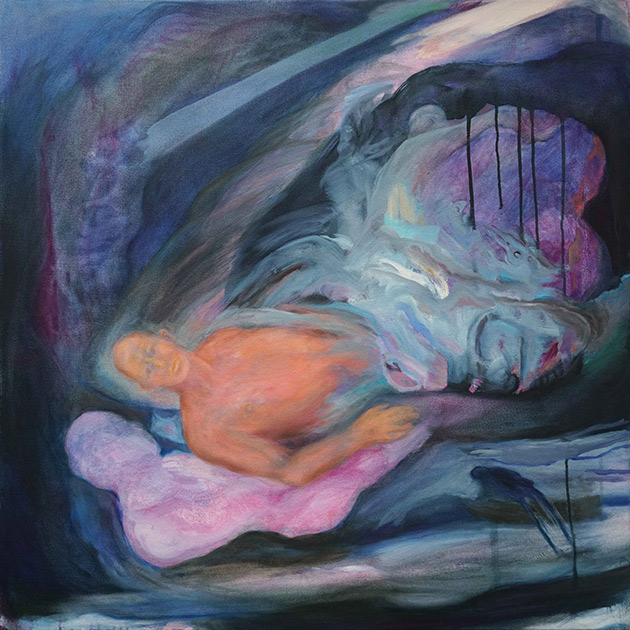
CBP: You have a background as a trained Gestalt and Body Therapist. How does this practice connect and influence your painting practice? Do you interpret fragments of stories, maybe abstracted and an understanding of the human psyche from this experience?
MVB: I believe I have indirectly expressed my desire to understand the mystery of ‘psyche’ more deeply by gaining a clearer understanding of how it functions within me. When I mentioned that painting came to me as an imperative, it reflects how strongly that drive persists – both as my desire to make art and to comprehend what it achieves in communication. However, thinking or experiencing ‘psyche’, which is central to my work, opens doors to areas I prefer not to make assumptions about that don’t serve anyone; I am not religious, but I acknowledge a strong feeling for transcendence, which I choose to view as – I don’t know how many – layers of immanence imbued with life.
I was a highly imaginative and sensitive queer child, and learning as an adult to consciously relate to and trust my body, sexuality, and creativity – recognising defensive or ‘armoured’ aspects – has been a vital journey. It has helped me stay grounded ‘in my body’ while working with these elusive yet real themes of my choice, through colours, materials, and by engaging with what is essentially an interaction between intuition and energy. Gestalt Therapy encourages a creative and empathetic approach to unknown, energetic zones, including blind spots, so they can be addressed directly rather than projected onto others who have nothing to do with these contents. That doesn’t mean avoiding challenges when necessary.
I have observed that people can feel uncomfortable when I mention an energetic, transformative vessel between two individuals – a concept Carl Jung used as an analogy for the analytical process between client and analyst, drawn from medieval symbolic alchemy, where both parties engage on a deeper level. But it occurs, in my experience, in much less formalised situations when people fall in love, build friendships or are willing to relate in meaningful exchanges, for example, about their art practice. I extend this idea to me and a canvas, seeing the vessel there as containing an energy field that seems to communicate with me as I work, indicating, after many deviations, try-outs, wiping away, layering, and bold or careful moves, when the piece is complete. When I listen attentively, I believe a painting can touch on something that concerns others and resonates beyond my personal interest.
I abandoned my one-to-one practice many years ago to focus on making art, but of course, it has left an imprint. However, I have never focused on confidential client material or their stories in my work, as that would conflict with my ethics. As I said, I aim to transform elements of my own story by approaching it quite analytically and weave in into decisions about the structure of an image (frames, lines of flight, hidden or emphasised elements).
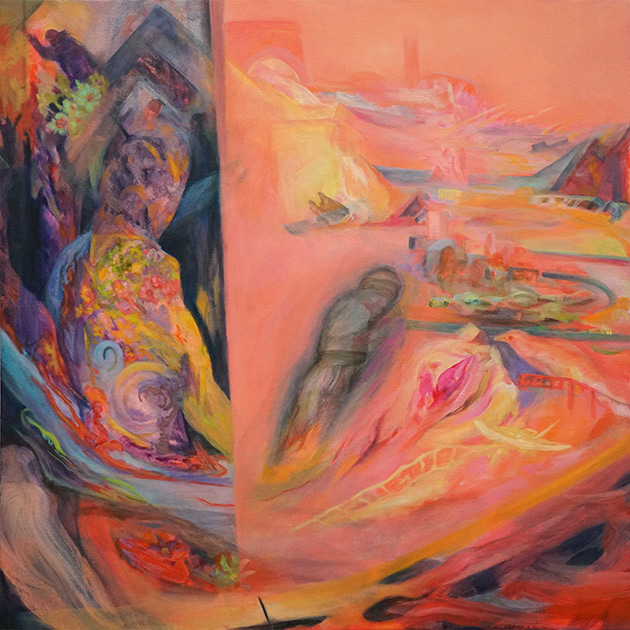
CBP: You have previously talked about the influence of literature in your painting. Can you discuss examples and how they are embedded in your paintings?
MVB: As a much younger person, after training at a publisher specialising in contemporary literature and studying German Literature and Philosophy in Frankfurt, I worked as a freelance editor and wrote quite a lot myself.
Modernist literature and poems (those which don’t rhyme) have had a profound influence on my thinking about how to structure a painting. Virginia Woolf’s writing, for example, is informed by close observations of how memory operates in her mind. There is a contemporary parallel in Henri Bergson’s thinking, whose work I admire. He distinguishes between static perception and the reality of permanent change of all things in time, and talks about the layers of experience in memory that we pull up, and thus actualise as presence.
Poems (I think here to the use of German language in Rilke and Paul Celan) have the great advantage of disturbing the idea that normal speech can really deliver correct understanding between us – the poem breaks information into fragments that can interweave various levels of associations and time and can, exactly by remaining ambiguous, communicate more by amplification than ‘correct’ or representational speech. I apply this kind of thinking to my painting – for example, by visually alluding to otherwise incompatible layers, which are involved in perception yet impossible to communicate as a ‘straight’ line.
The subject concerns translation on various levels. English is my second language, and living in the UK since 1994, I still think and even dream in both languages. Certain things remain untranslatable.
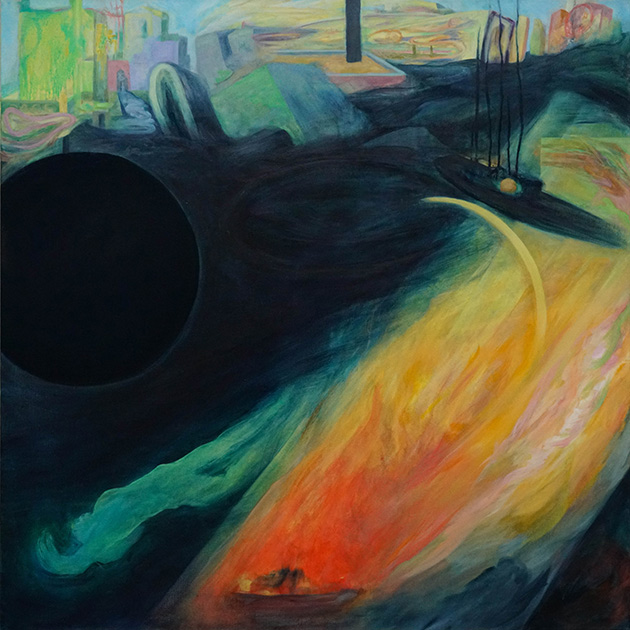
CBP: You talk about the influence of alchemy in your work. In the book ‘What is Painting’ by James Elkin, the author discusses alchemy and its relation to chemistry and the making of paints and colours. What are the influences on your colour palette? Your paintings appear very warm, chromatically vibrant and subdued and feel like they represent something fluid inside a body.
MVB: A significant part of my practice-based PhD research at Winchester School of Art involved working with rare illuminations from alchemical treatises of the early Renaissance, such as Splendor Solis and Aurora Consurgens. Created for secret circles due to their heretical content, these works still carry the rarity and quality of unique manuscripts, kept in only a few libraries worldwide. I was fascinated to observe what occurs, in terms of painting and conceptual thought, when I use digitised, scanned fragments of these esoteric, one-of-a-kind works, project them onto my canvas or paper, and respond by making new, contemporary, unique, handmade oil paintings alongside drawings with coloured pencils and digital videos; i.e., the experiment explored how, if possible, to merge ‘authenticity’ (the handmade) with ‘dissemination’ (the digital). Alchemy captivated me because it is one of the rare models of thinking that addresses both spirit and matter without dividing or separating them; the main operations of the Great Work of the alchemists, which serve to transmute the abject into gold, cannot be considered without entangled, transformative fusions of both. Even the goal – the ‘red stone’, the ‘stone that isn’t a stone’ – symbolises a rejuvenation achieved after difficult phases of symbolic death (colour black) and purification (colour white), as a material yet immaterial, truly ambiguous end product. It is both Vermillion red and the alchemist’s connection to and mastery of life force. I previously mentioned balancing colours, timelines, and ‘forces’ in a painting: these topics are highlighted in alchemy, especially in the encounters of fire and water (I see colours and movement for this encounter instantly, imagining both) in alchemical processes – which always relate to time – are prime examples of working with opposites and observing conditions that enable them to operate together without extinguishing each other. Vermillion or cinnabar is such a fusion (chemically mercuric sulphide) or alchemical opposites, sulphur relating to the element fire, mercury to the element of water (or spirit). For me, the most significant figure – a temporary yet crucial stage of the ‘Great Work’ – has been the Hermaphrodite, a symbolic fusion of male and female that is also conceived as a physical unity of gendered bodies, as depicted in the illuminations. The Hermaphrodite proposes, perhaps more idealised than practised in its time, true equality between the sexes. From my queer perspective, it also affirms the psychic fusion of both within an individual, dissolving the assignment of how to be and feel in/with one’s body.
The opposites or polarities mentioned translate into my paintings as fragmented elements from the illuminations, as well as working with complementary colours, flux and fragmentation, free-flow and inserted frames, ‘male’ and ‘female’ colours, etc. When it comes to colours and ancient alchemical recipes, though, I have been referring to alchemical colour symbolism while lazily relying on ready-made colours. Blackening, the symbolic death in alchemy and often associated with the Egyptian god Osiris, underpins many of my works since 2011, and I have found my favourite black to be a mixture of indigo, orange, and scarlet (which comes quite close to vermillion). I like the idea of ‘greening’ in alchemy, which refers to both decomposition and new growth. I find it challenging to produce a good painting that emphasises green (my favourite hue has become Cobalt Green, which I use sparingly as it’s expensive!). Scarlet red has the fire I seek without being too ‘loud’. I enjoy working with pink (as a transparent layer of Scarlet, or mixed with Magenta or orange and lead white), because, depending on the hue, it radiates something soft but vibrant. However, there is also another side to it: gay men were targeted and killed in Nazi concentration camps, where they had to wear pink triangles sewn onto their garments; in the 1970s, the German gay movement reclaimed the historically charged pink, which became relevant for my personal development in my early twenties.
When you ask about the warmth of the colours in my paintings, I believe these hues naturally attract me, likely aligning with my desire as an artist to explore layers of immanence infused with life. I wish to invite viewers to look at emotions that can be uncomfortable but coexist with others (fear, love, confinement, freedom, etc.) and try to relate to viewers on a feeling level, while being absent as a person.
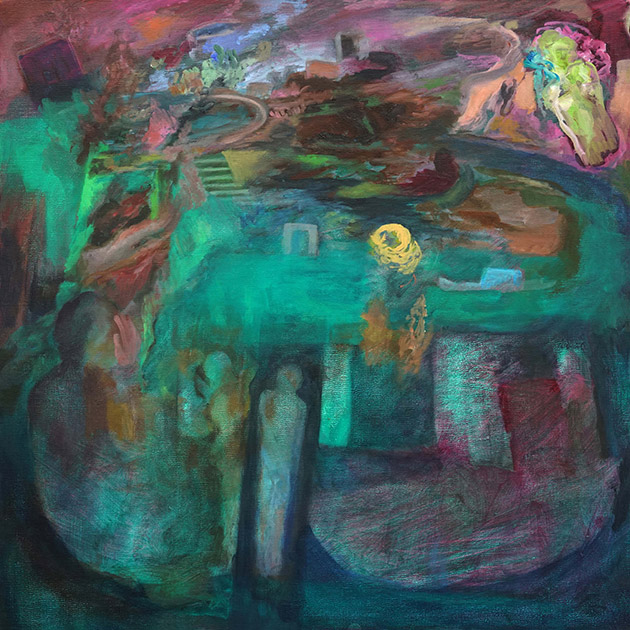
CBP: Can you talk more about your painting process? Do you start with or work from drawings or studies, or is the drawing more embedded in the painting process itself?
MVB: As mentioned before, observational drawing, especially life drawing, supports my freedom to get bodies or allusions to bodies right in a painting without too many problems. Almost none of my paintings are planned; that means I don’t prepare studies or drawings. However, when a figure that emerges during the painting process needs greater detail, I will find a photograph for a drawing study to help me progress.
A painting evolves through a negotiation of spontaneity, structural editing, figurative elements, and sometimes projections of digitised components from photos or scans (from alchemical illuminations); and through balancing these aspects. I have been told that the paintings look as if they were planned, but what you see is the result of an at times long and truly frustrating negotiation process. I like the adventure of not knowing where to go, and that is the price I have to pay. It’s very rare that I give up on a painting.
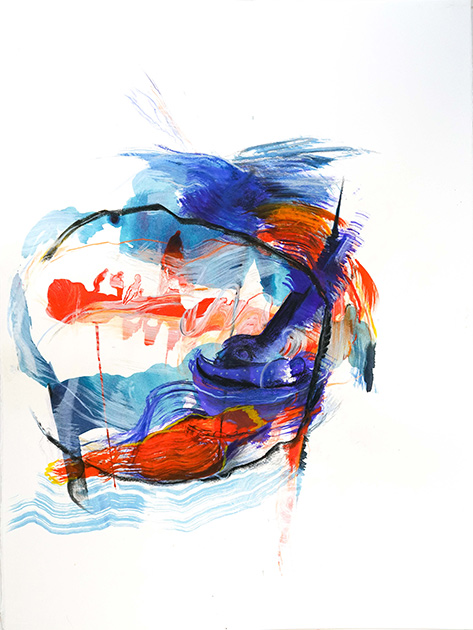
CBP: The fluidity of your painting is enhanced by the layering and transparencies in building space and the experience of time in the works. Can you discuss your process in terms of fluid gesture, layering of form and the concealing and revealing in your work?
MVB: I aim for the viewer (and myself) to have a haptic visual experience, one that invites the eyes to ‘touch’ the canvas without primarily being directed towards representations of figures and objects. I think that is possible when the painting has no real centre, works with an interrupted fluency and distracting details and doesn’t fulfil the expectation of a ‘stage set’, a theatre, or a gaze that looks back at you.
The transparencies (wiping away and adding again) can sometimes create a surprising, unexpected, and disjointed horizon, hinting at an incomplete space within the rest of the painting. Colours can appear almost ‘pure’ in this way, like in coloured glass windows, especially by contrasting them with other layers.
Concealing and revealing – or hide and seek -, that is my love for small details, for ‘minor’ things and incomplete narratives – I love to discover such traces in paintings by others, in books and music; they can open up a whole world of associations for me.
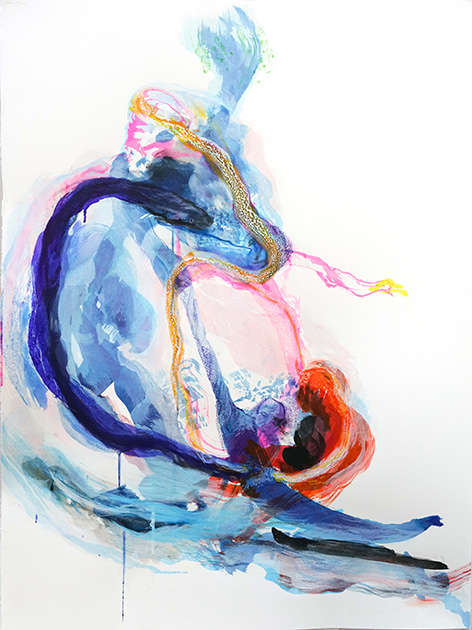
CBP: Your paintings emit their sense of light as a glow from their dark grounds. A recent body of abstract works on paper, for example, Coil 1 works with their gesture and figuration on a white ground, as drawing/painting hybrids. Are these more immediate, spontaneous creations?
MVB: What you observe here, – light as a glow from a dark ground – is perhaps the briefest way to sum up what I aim to achieve in my paintings. It links back to the beginning of this conversation, to ‘chaos’ and that somewhat imperative drive to paint while connecting to an energetic presence; and transforming this connection by simultaneously imposing order, that is, a coloured and ‘lit’ structure upon it. This process reminds me of a rite of passage, and I understand when artists compare their work to that of a shaman, whose function within a community is to address unsaid and broken dreams, which often are invisible yet unresolved layers of social reality.
Most of my work is driven by questions about understanding this phenomenon, exploring how it works and contributing to ideas about it that go beyond psychological explanations of sublimated sexuality.
In real life, many people find it very challenging to confront their own darkness and fears, and I understand that. I also wonder whether it is perhaps idealistic to place political realities in the same context as this kind of courage; as an artist, I am able to and have to do so.
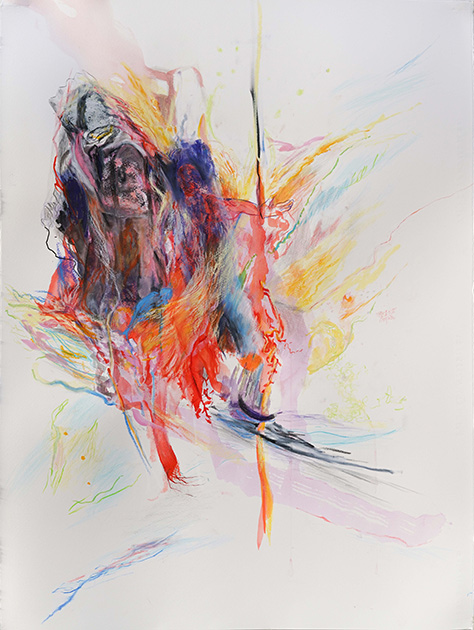
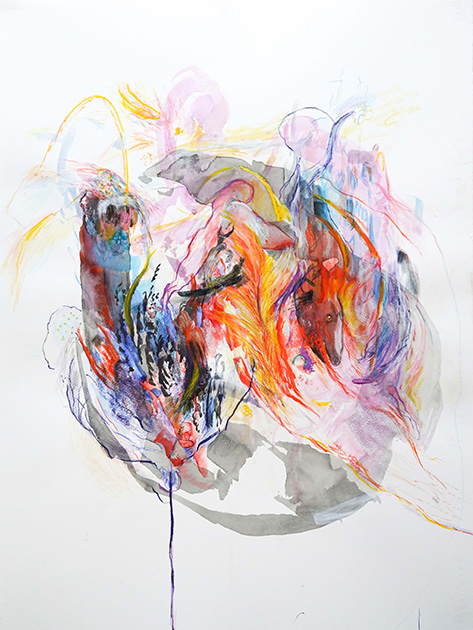
In the works on paper (all on full-size, smooth watercolour paper, 300 gsm), I enjoy leaving ample breathing space, as in classical Chinese art. For many years, I used only coloured pencils for such works (I love them; perhaps they remind me of drawing as a child), and the open space allows the colour lines to stand out more clearly, to have their own life. Then I added watercolours, ink, and oil pastels; combining all can produce really beautiful, radiant colours.
The gestural element is more prominent in these works; however, at closer inspection, you’ll find developed minute stories and details that, at least for me, connect to and complement the paintings.
When working on the Coil series, I had a tensed spiral in mind – and unwinding instants of presence and memory. The series On Butterflies I approached like an essay on the state of suspension within metamorphoses: flooding vs unfolding, temporary stagnation, disorientation and potential. The essay got much longer than expected (like this interview).
CBP: I understand literature has an important imprint on your painting, though, how do you negotiate the titling of your work?
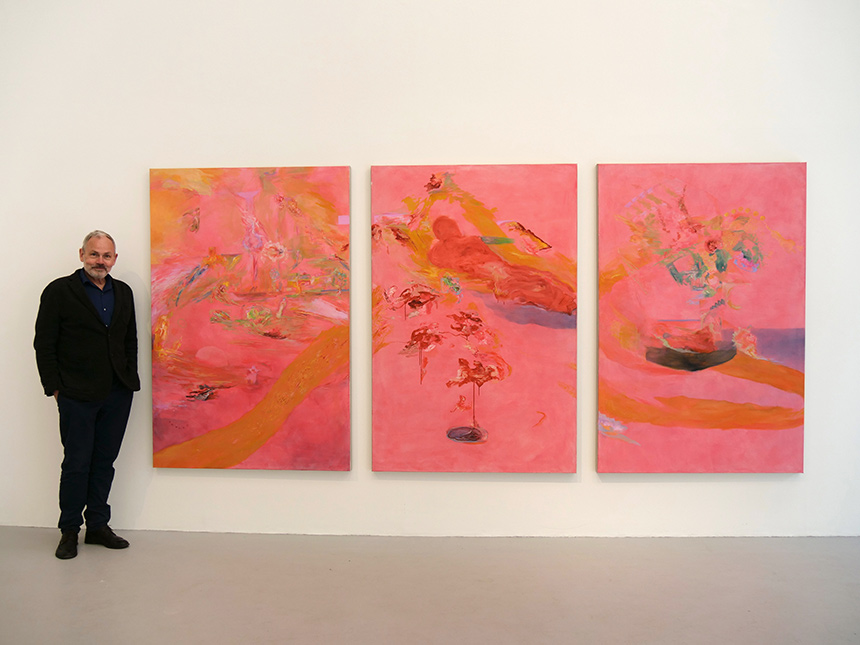
MVB: I’d like to give an example: the title and you’ve been wholly remade into feeling for a mainly pink triptych from 2018, is a line from a poem by Constantine Cavafy, a Greek poet. Much of his poetry reflects brief or even fantasised encounters with men; it is sensuous, secretive, and realistic, and has intrigued me for a long time. My triptych is about love, more specifically, about realising that in my over thirty-year-long relationship with one man – each of us changing, both independently and together – a world of memories has built up, which, from over thirty years ago or from yesterday, – it doesn’t really matter – are, at the core, somewhat disembodied but powerful condensations of love; they have been remade into feeling, as Cavafy writes. And at the same time, the title opens this experience for everyone.
I used another line by Cavafy for our blood and skin understood (The Sleepers) from the same year. It relates loosely to the triptych, but from the angle of the intimacy of sleeping close to each other, each dreaming, and meeting for an instant in a shared invisible ‘inscape’. I avoid descriptive titles to prevent redundancy in the painting or title.
The title for last year’s The Word I couldn’t Find is an admission of being clueless about how to call this painting, on the one hand, and, on the other, of the truth that this painting deals with something I can’t translate into language.
CBP: Can you describe a typical day in your studio? Do you have several works in progress at one time?
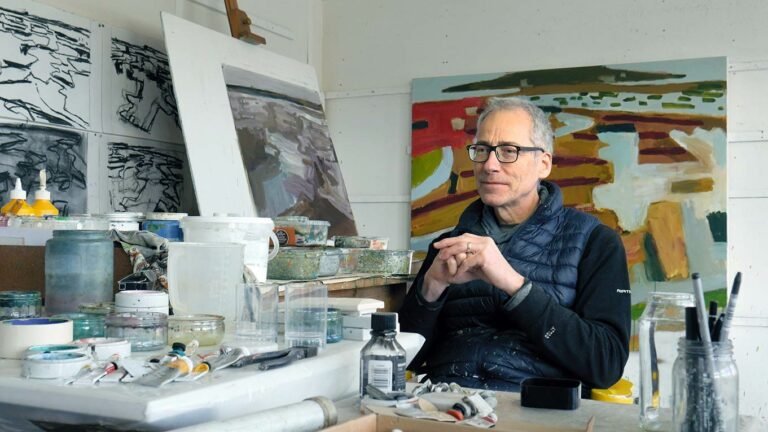
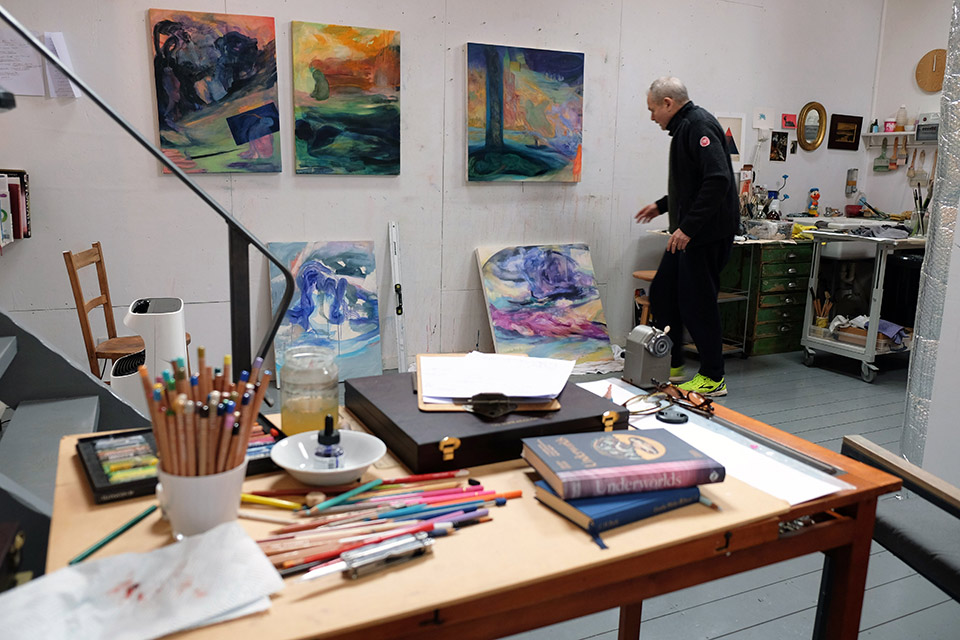
MVB: It depends on outside interferences, admin duties, or social media work, which can take me, though only requiring about an hour or two, away from being ready to ‘tune in’ for several hours. Normally, I like to work in the studio for a few hours straight in the morning and afternoon; that can mean painting, reading, drawing, or sometimes, if uninspired or distracted, just sitting and watching the trees outside (I have my studio on the Isle of Wight). If working on a larger canvas, I don’t start with others but focus on the mostly dry zones or continue with other works on paper (always in series on the wall so I can switch between them, depending on what comes to mind).
Currently, I have about five mid-sized canvases on the wall; it’s a new beginning after a difficult year. I have been dealing with the long ‘block’ by stopping to force myself to work and allowing that ‘imperative’ to recharge (for example, by watching German language crime series on TV, which relaxes me and is, at times, my not-so-guilty pleasure).
Simply spending some time with myself in silence (my way of meditating) is the best preparation for my day in the studio.
Thank you for your inspiring questions, Paul!
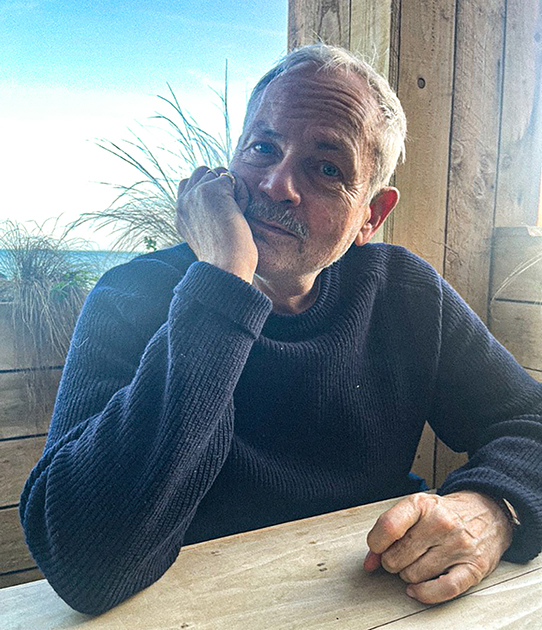
German-British painter Marius completed his practice-based PhD in Fine Art Painting at Winchester School of Art. In 2013, he was awarded the Abbey Fellowship in Painting at The British School in Rome.
He has a background in psychotherapy and literature and has been teaching experiential approaches to painting and courses on art and literature. He works from his studio in Rookley, Isle of Wight. His work is in the Priseman Seabrook Collections, the University of Essex Modern and Contemporary British Art Collection and private collections. He is currently CBP’s treasurer.
Recent exhibitions include: 2025, ‘Darkness Visible’, APT Gallery, London, ‘Atemkristall’, Blyth Gallery, Imperial College London. 2024 Portfolio, Quay Arts, Isle of Wight, ‘Slow Painting – Cultural Landscapes and Surface Tension’, The Plough Arts Centre, Torrington, and StudioKIND, Barnstaple, 2024 Assembly, Rye Creative Arts, Rye 2023 ‘Black Sun, Braided Time’, Jenn Singer Gallery, New York, NYC (solo).
Jenn Singer Gallery represents Marius von Brasch.
Instagram: @mariusvonbrasch
https://www.mariusvonbrasch.co.uk/