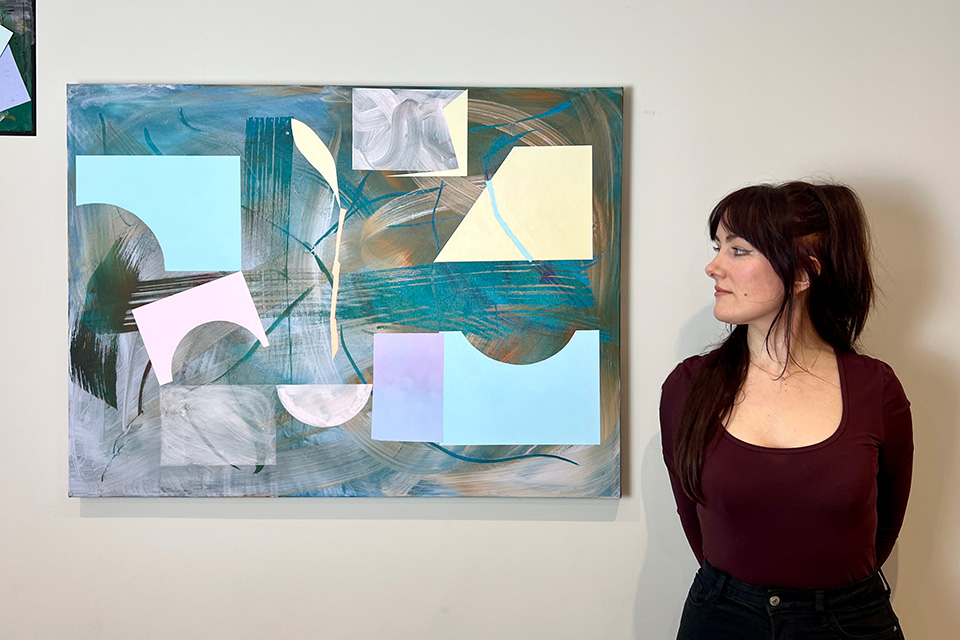
Lisa Denyer: Artist of the Month
Artist of the Month December 2025:
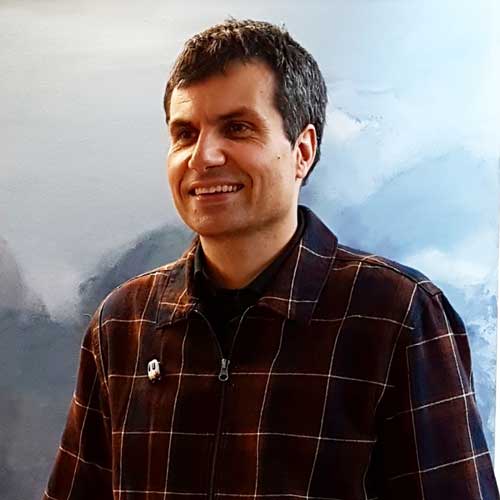
Lisa Denyer, selected and interviewed by Paul Newman for CBP.
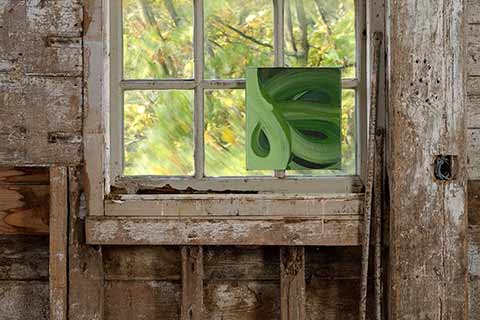
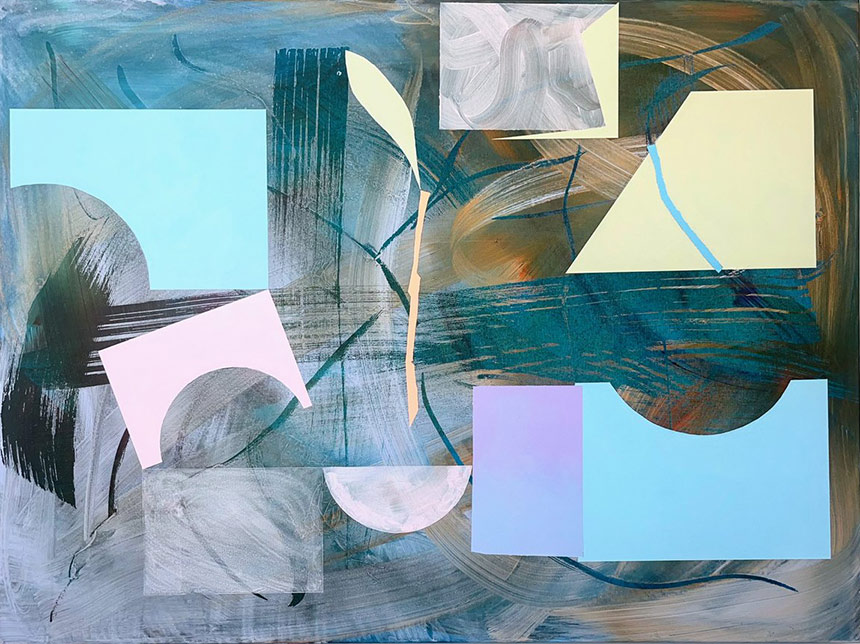
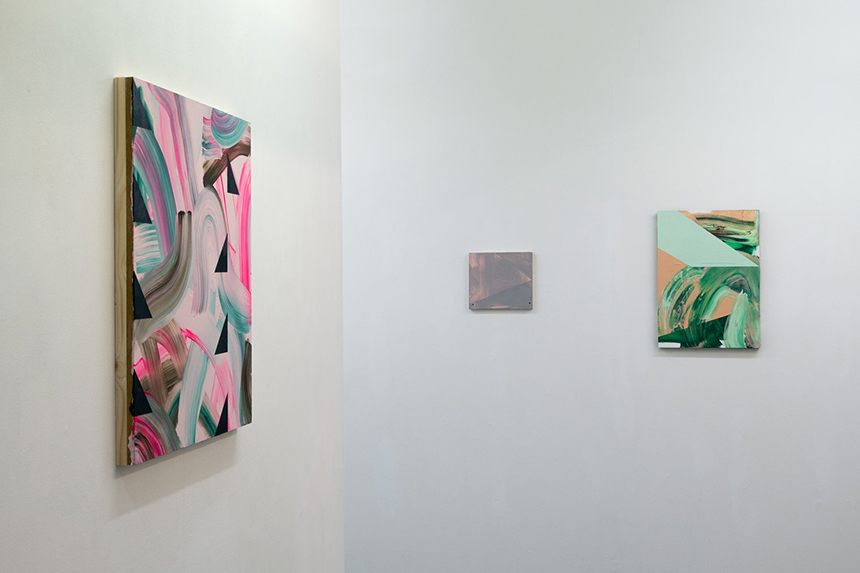
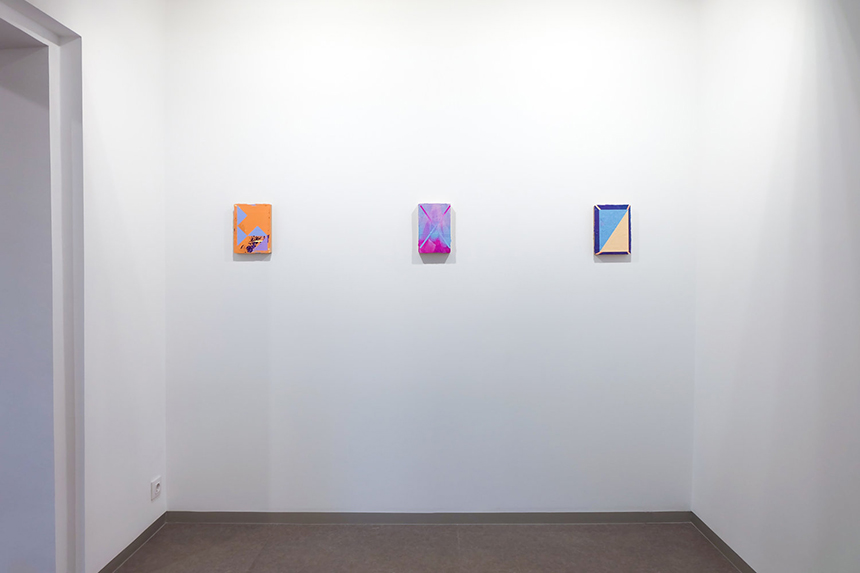
Lisa Denyer’s practice explores the polarities of a slow, considered painting process against the speed and sensory perceptions of daily life. The work relates to the body, the spaces we inhabit, and the visuals we encounter on a day-to-day basis.
Surfaces are developed using paper cut outs in an approach that is both spontaneous and contemplative. Geometric elements and gestural marks are tested on a variety of substrates including weighty plywood, clay, canvas, panel, and sandpaper. These materials are selected for their textual qualities and for the way they assist, and disrupt the application of paint.
CBP: What are the starting points for your abstract paintings of gesture and geometry?
LD: I work from an intent to capture the contrast between natural, spontaneous gestures and the order of geometric structures. I’m drawn to how these languages can coexist. To me, the intuitive mark suggests emotion, something organic and raw whereas geometric forms introduce the idea of containment. The work evolves through balancing these opposing forces until they reach a kind of equilibrium. I see this interplay as reflecting how we navigate and impose structure on our lived experience where moments of control coexist with the unpredictable.
CBP: Can you discuss the use of collage in the development of your work and how you incorporate ‘chance and contemplation’ mentioned in your artist statement? Abstract paintings exploring colour, materiality, spontaneity, gesture and control.
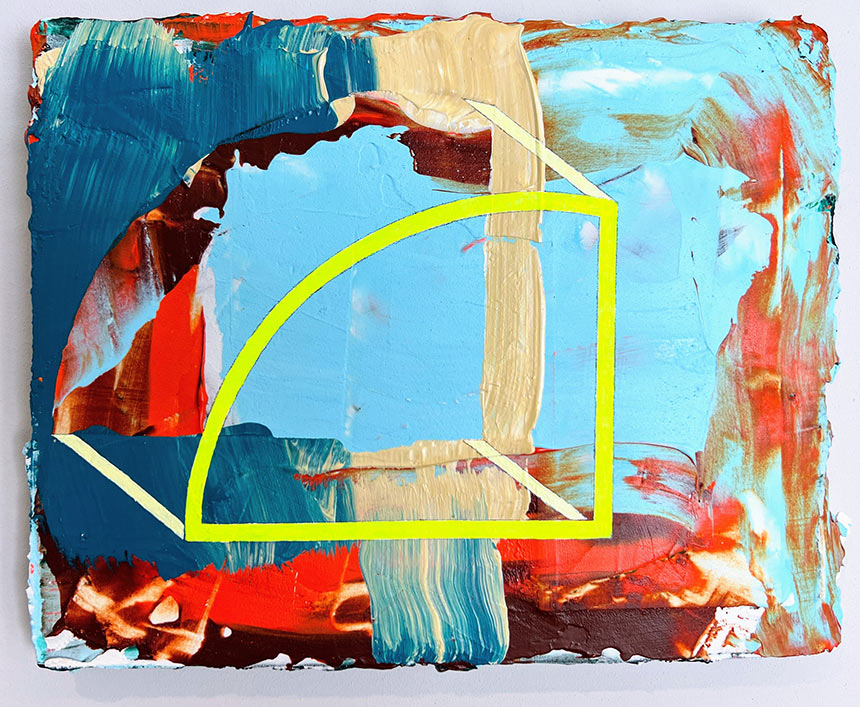
LD: Collage plays an important role in the early stages of my process. I use it as a tool to create elements of chance, disruption, contrast and reconfiguration within my paintings. Each piece of work starts with layers of gestural marks. Once I feel that this initial surface shows enough promise I begin to ‘frame’ these marks with paper cut outs.
I often work intuitively, arranging and reworking the composition until relationships between colour, form and mark begin to emerge. This stage involves a balance of chance and contemplation. The geometric elements operate as a way to create structure, to frame or interrupt the initial dynamism of the paint. Often, placing the cut outs generates unexpected visual outcomes. I feel this gives the work a certain energy which is eventually tempered when the final composition manifests. The process is an ongoing negotiation between spontaneity and control.
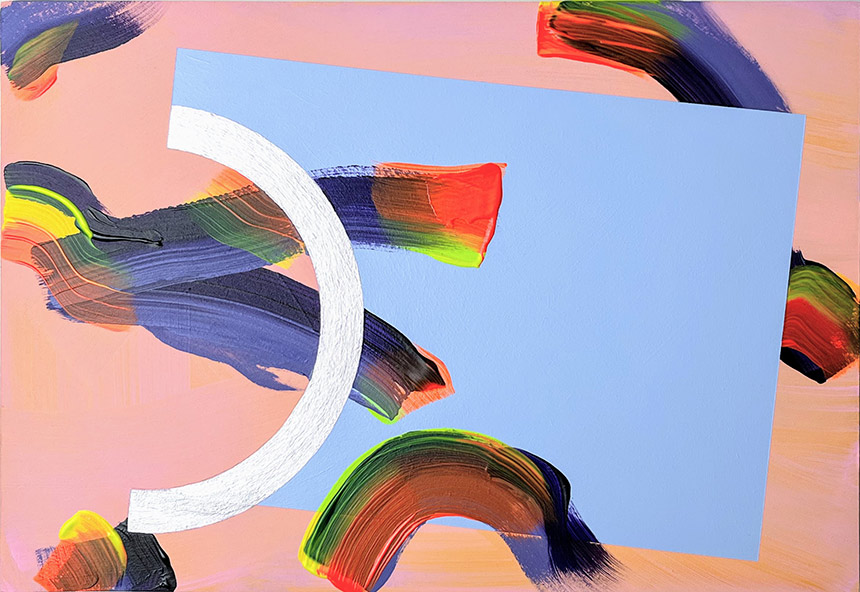
CBP: What’s the studio set up like for this process? Do you have studies spread across tables or carefully arranged on the wall? I guess I’m intrigued in the relationship between order and chaos, system and spontaneity in how you set yourself up in your studio.
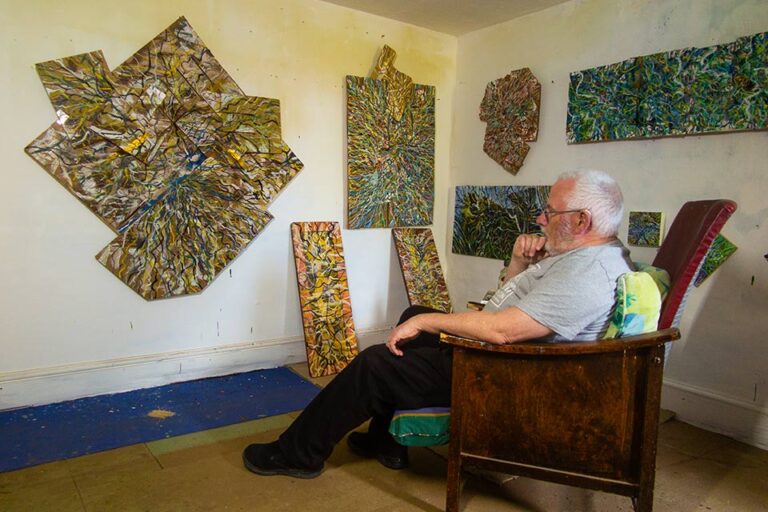
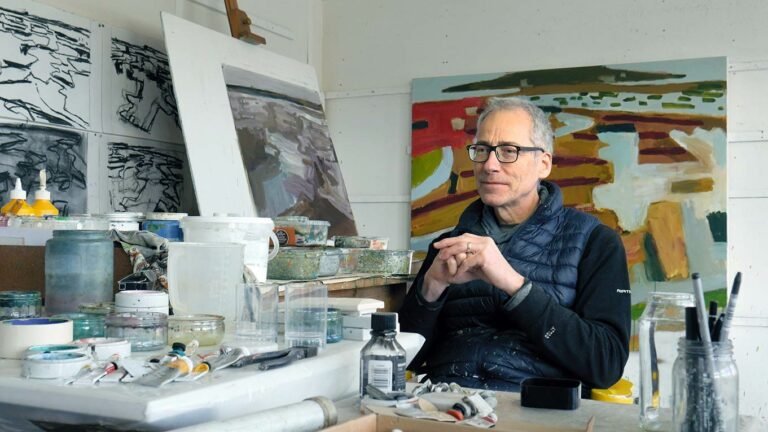
LD: I suppose my studio set up mirrors the balance between structure and unpredictability which I’m always negotiating in the paintings. I like to create an environment where both can operate at once. The walls are where the more resolved works-in-progress live, along with smaller studies, notes, fragments, and colour tests. Seeing things upright helps me understand the spatial dynamics and how different surfaces are developing in relation to one another.
The tables are where I actually paint. I keep a box of cut outs to hand loosely grouped so I can shuffle, rotate, or reconfigure them as I work. I often make quick painted tests on paper or card, and these accumulate in piles that I dip into when I’m looking at a new direction or a different kind of mark. Even though there’s a system underneath I try not to over control it. Sometimes an accidental alignment on the table or an offcut lying on the floor can spark a new compositional idea.
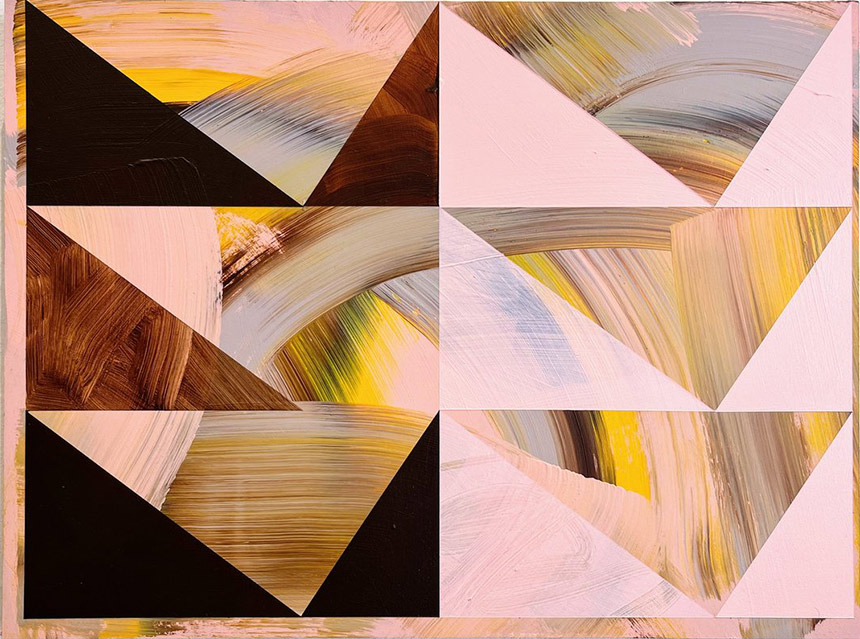
CBP: In ‘Chaos, Territory, Art: Deleuze and the Framing of the Earth’ Grosz (2008), Elizabeth Grosz talks about the notion of the frame; in art, architecture and the natural world as the device we construct to create order in nature for ourselves. You could consider the geometry and architecture in your painting as a way of creating order in relation to the chaos of gesture. However, the gestural marks have their sense of order too. Can you discuss the relationship between these elements in your work?
LD: I’m really interested in Grosz’s notion of the frame as a means of creating order within a complex field. I definitely see the dynamic between spontaneous, gestural mark-making and more structured, geometric forms as a dialogue between order and chaos. The geometry in my work often acts as a kind of framing device, the structured elements providing a point of focus or containment for the more fluid, intuitive gestures, which carry their own internal rhythm and sense of logic. I see the two modes as codependent as the geometry gains energy from the surrounding spontaneity, while the gestural marks find grounding in the shapes.
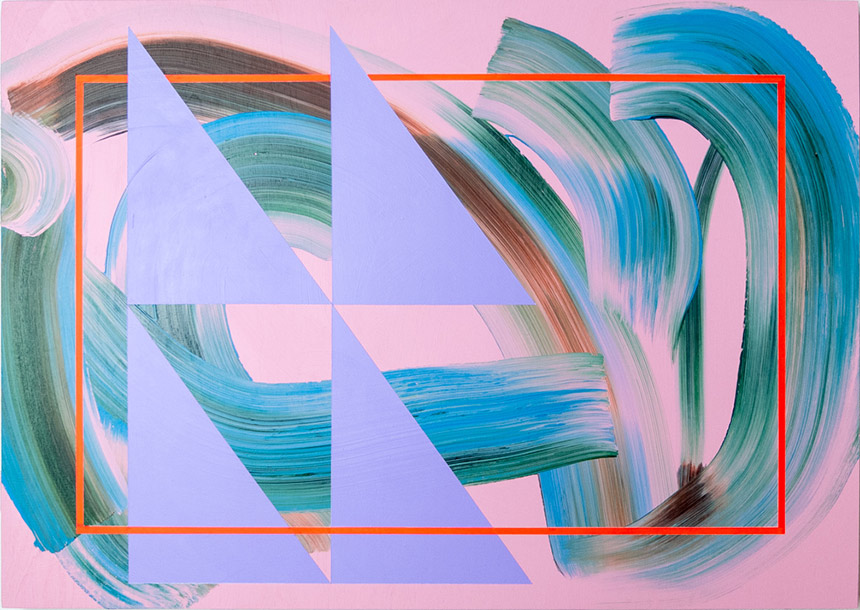
CBP: What does ‘landscape’ mean for you in your painting?
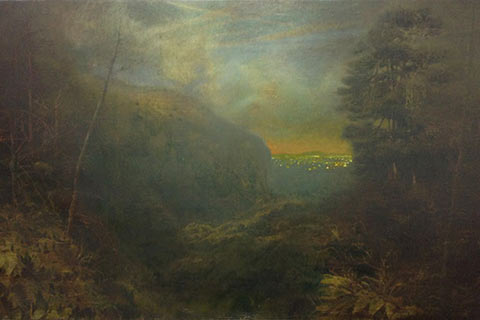
LD: I started out as a landscape painter and I definitely feel that some of those themes carry through to my current work in terms of how I think about space, depth and the way forms relate to one another.
In my current practice, landscape is more of a conceptual structure rather than a subject. It’s a way of organising movement, form and space across the surface. I read the novel Flatland some years ago, and I still think quite a lot about the concepts it presents, particularly how it plays with dimensionality and how space can be constructed, collapsed or expanded within a two-dimensional frame. I’m interested in how a painting can hover between worlds; suggesting depth while asserting its own flatness, or creating zones where competing spatial logics can coexist.
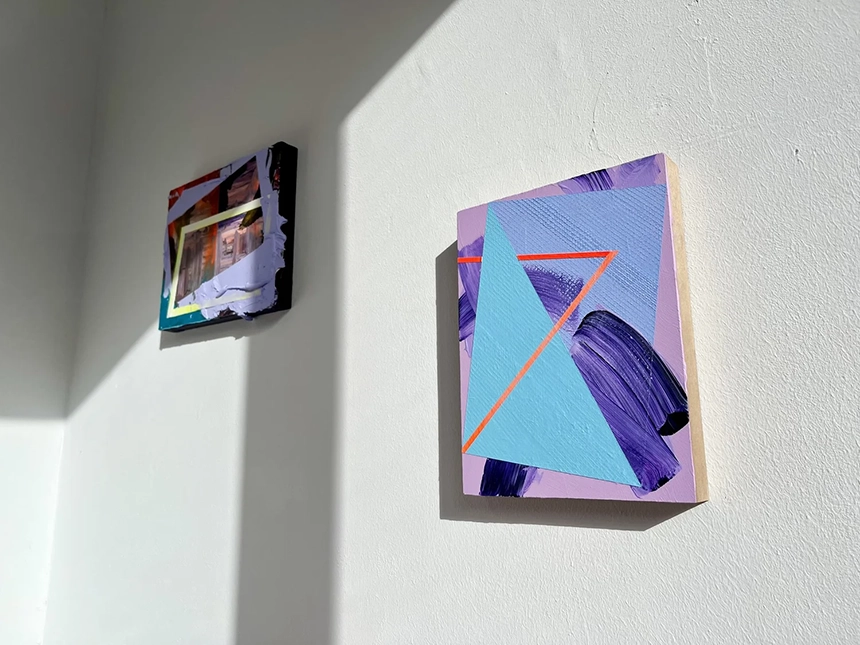
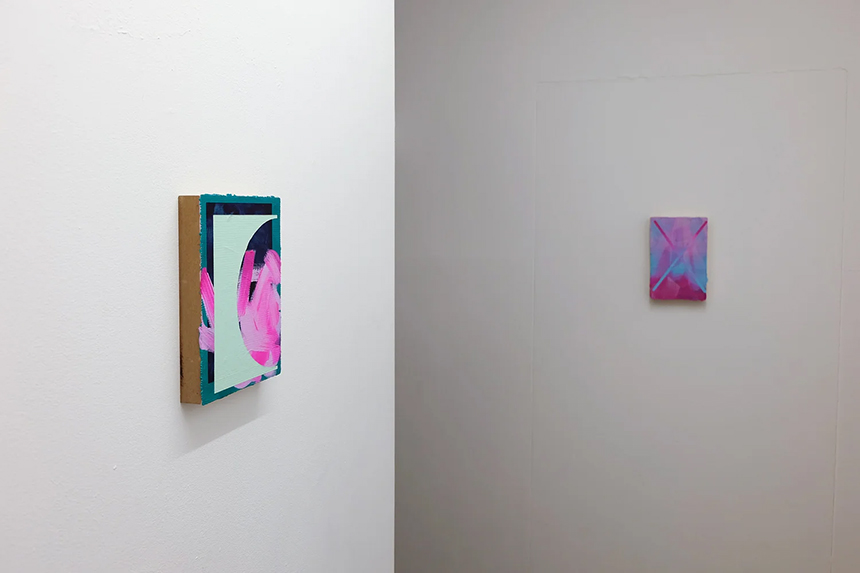
CBP: There is a dynamic push / pull between the gesture and geometry in your work, the later doesn’t just sit on top, In a painting like ‘Landmark’ its woven in. This painting also uses transparency to veil the history of the layers and create natural ambiguities and contradictions in the construction of space. Can you talk about these strategies and the exploration of space in your work?
LD: The push and pull between gesture and geometry creates a kind of internal tension, where no single element is dominant for long. I’m interested in creating moments where different logics of space can coexist, and how the intuitive nature of the gesture against the measured intent of geometry can unsettle each other yet shape the spatial logic of a painting.
In a piece like Landmark, the geometric structures don’t sit as a graphic overlay, they emerge through the same process of accumulation, erasure, and adjustment as the gestural marks. Usually I use flat colour for the shapes but for this piece they are almost like ghosts, which I felt worked alongside the landscape elements. This was quite an experimental piece for me, in which I played around with ideas of foreground and background. The shapes are almost embedded, allowing the geometry to act as both anchor and disruptor. It can stabilise a field of movement, or fracture it, depending on how it’s placed and how visible it remains.
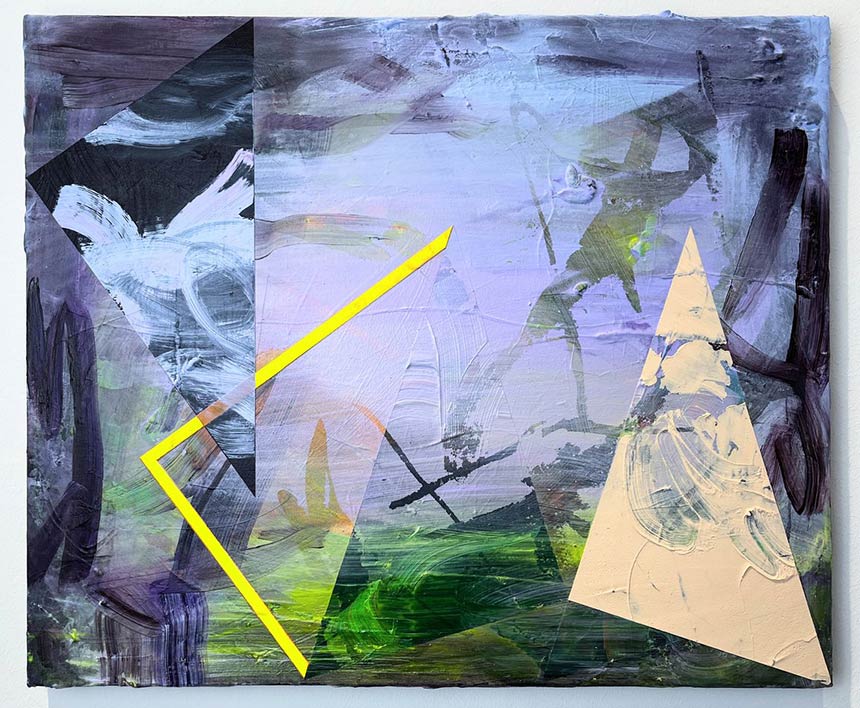
Transparency plays a key role in constructing this shifting space. By veiling earlier layers, traces of previous decisions remain active on the surface without being fully readable. This partial visibility sets up small contradictions where forms appear to recede and advance simultaneously, or occupy multiple positions within the same plane. The result is a space that isn’t fixed but negotiated.
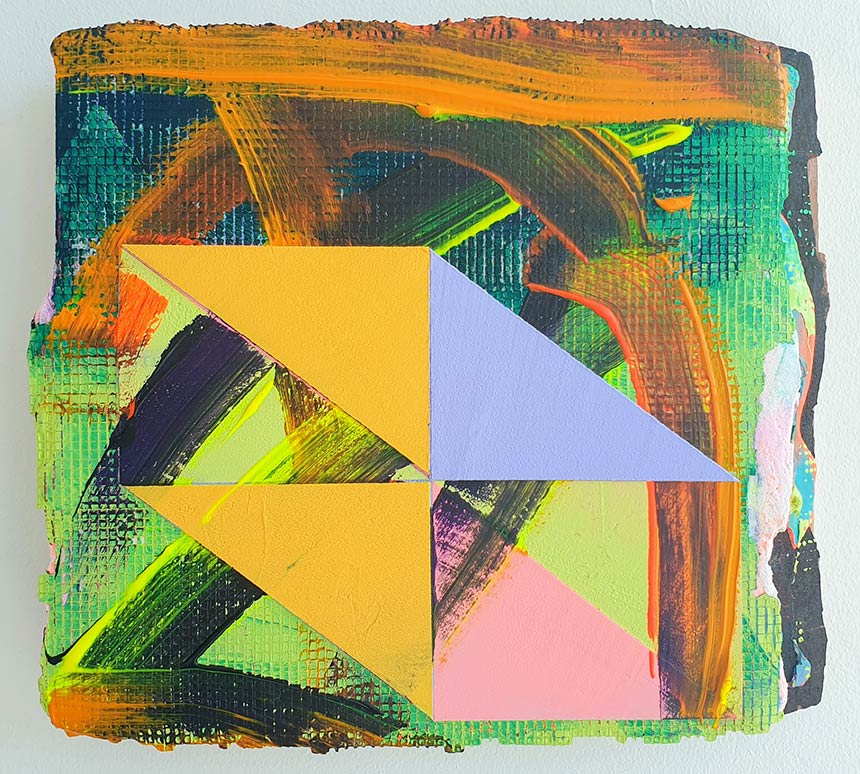
CBP: Masking off appears important, not just to create sharply defined edges for visual contrast but to build surface and physicality between edges. Can you discuss your use of this technique?
LD: I use masking tape to create clean edges which usually contain flat areas of colour to set up relationships between gesture and geometry. I want to highlight the contrast between those two aesthetics which is why I feel the precision of masking tape is necessary for the architecture of the painting. It offers a counterpoint to more fluid, intuitive marks, sharpening the sense of tension between spontaneity and control. As well as that, the process is akin to print making in that there is an instant ‘reveal’ moment after the tape is removed which keeps the momentum of the painting going.
I do want to create moments where the surface becomes physically built through the repeated application and removal of paint. Each time I mask off an area, paint into the boundary, and then peel it back, it leaves behind a subtle ridge which creates ambiguity around the materials used. The masked shapes and lines also introduce depth, creating shadow and changes in reflectivity that alter how the painting catches the light. This helps the work sit somewhere between image and object.
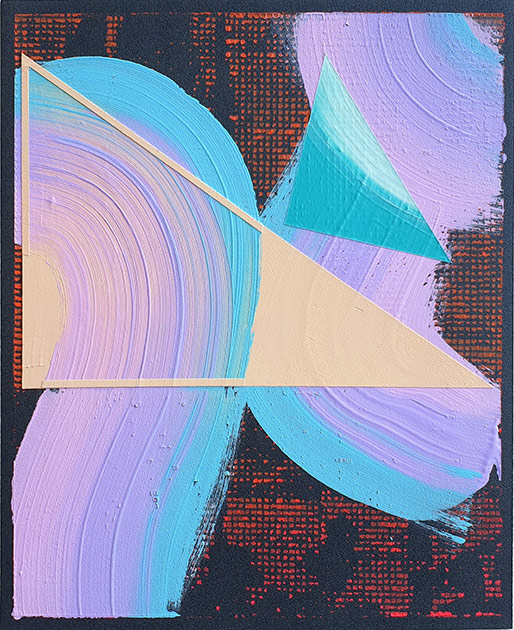
CBP: How do you explore colour and light in your painting? Do you respond to pigments and material, or are your palettes based on the observed, recorded and collected from our built and natural environment?
LD: I’m interested in how different colours behave on the surface, how certain colours push forward, sink back, or create unexpected transparencies when layered. At the same time, I’m continually absorbing colour relationships from the places I move through. In every city I’ve lived in, I’ve noticed a change in my work. I’ve recently moved to London and have already noticed the influence from details such as graffiti, architecture, branding, logos and fashion. Something I’ve been thinking about a lot recently is how artificial, neon and fluorescent colours sit alongside natural, more organic tones. These impressions don’t always translate literally, but they do often filter into the work. So the palette becomes a hybrid which is rooted in the physicality of paint while also shaped by the visuals I encounter on a day to day basis.
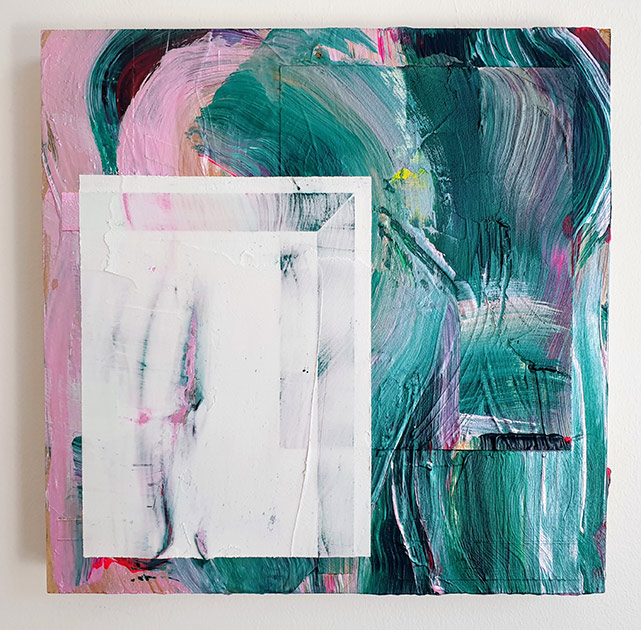
CBP: In more general terms what’s the journey like for one of your paintings? Do you have a number in progress? How long can they take, and do you complete all your works?
LD: The journey of each piece is quite open-ended. I usually work on around four paintings at a time so I can move between them. That seems to allow each piece to develop at its own pace without being too forced. When one reaches a point of uncertainty, I can shift my attention to another and allow the first to settle. Having that pause often lets me gain perspective and reveals the next step more clearly than pushing through ever could. Something I always do is to photograph the paintings in progress at each stage. This is vital for thinking about the next step, especially when I’m not in the studio.
The time they take varies enormously. Some paintings resolve themselves quickly, while others take months. Occasionally a piece needs to be set aside altogether to come back to at a later date. There are works I’ve returned to years later with a completely new understanding of what they needed. In that sense, every painting has its own timeline, and part of my practice is learning to recognise when something is finished, when it still has more to give, and when it needs to rest for a while.
Because of this, not every piece reaches completion in a linear way, but most eventually find their form. The ones that remain unresolved often become catalysts for new directions, so even the unfinished work has a role in the wider studio process.
Bio text
Lisa Denyer graduated from Coventry University in 2009 with a BA (Hons) in Fine Art. In 2010 she received second prize in the Gilchrist Fisher Award, held at the Rebecca Hossack Gallery, London. She was shortlisted for Salon Art Prize 2010, The Title Art Prize 2011 and Bankley Open 2013/14/15. In 2015 she received first prize in the PS Mirabel Open, and in 2016 she was shortlisted for Greater Manchester Arts Prize.
Recent solo and two person exhibitions include; 2023 – Colour Theory, OSKA, Edinburgh. 2021 – Strata with Elise Ashby, Paper Gallery, Manchester, curated by Laura Harris. Recent group exhibitions include; 2025 – Mancunian Heritage under the Spotlight, WPP, Manchester, Wrexham Painting Prize, Wrexham School of Art. 2024, Assembly, Rye Creative Centre, Slow Painting, Plough Arts Centre and Studio KIND, Barnstaple. 2023, Abstract Alchemy, Detail Gallery, Edinburgh. 2023, A Generous Space 3, Huddersfield Art Gallery.
https://lisa-denyer.squarespace.com
Instagram: @ldenyer